

① Hair loss is a symptom, not a diagnosis
The most important sentence in this article goes first: hair loss is a shared symptom of many different conditions, and roughly half of them have nothing to do with the hair follicle itself.
Every follicle runs a three-phase cycle. Anagen is growth, when the shaft lengthens. Catagen is a short regression phase. Telogen is rest, at the end of which the hair sheds so the follicle can restart. In a healthy scalp most follicles are in anagen and a small proportion in telogen — which is why some daily shedding is normal.
Pathological hair loss occurs when that ratio shifts: too many follicles enter telogen at once, or anagen shortens with each cycle so each new shaft emerges finer than the last — miniaturisation. Past a point the follicle atrophies and produces no visible hair.
Several factors govern the cycle:
- DHT and 5-alpha reductase. The enzyme converts testosterone to DHT; DHT binds androgen receptors at the follicle and drives atrophy. This is androgenetic alopecia — the most common form of hair loss and balding in both men and women.
- The Wnt/β-catenin pathway — the intracellular signal determining differentiation of hair germ cells. Weaken it and follicles cannot enter the growth phase.
- Microcirculation around the dermal papilla. As the capillary network thins, oxygen and nutrient delivery falls.
- Perifollicular fibrosis. In androgenetic and chronic hair loss, tissue around the follicle stiffens and constricts the root — which is why some long-standing cases do not respond to nutrient supplementation alone.
- Micro-inflammation around the follicular neck, driven by sebum, chronic dandruff and fungal overgrowth, or oxidative stress — a recognised accelerator of atrophy.
Two groups of causes, and why the distinction decides everything
Someone searching about hair loss is in one of two entirely different groups. Confusing them is the single most common reason people spend money without growing hair.
Group A — FOLLICULAR HAIR LOSS (the aesthetic group). The scalp is healthy: no infection, no visible lesion; the problem is in the follicular cycle. This includes androgenetic alopecia (crown balding in men, diffuse crown and hairline thinning in women, mechanism DHT-driven atrophy); postpartum, post-stress and post-illness shedding (telogen effluvium — many follicles shift into rest after an event, with heavy shedding months later); thinning and fine hair with age; and alopecia areata, which is immune-mediated and needs separate medical assessment.
Group B — HAIR LOSS CAUSED BY UNDERLYING SCALP DISEASE. The shedding is a consequence; the cause is an active disease on the scalp.
- Tinea capitis (scalp fungal infection). A fungal infection producing inflammatory lesions, scaling and localised patches of hair loss, often with itching and potential to spread. This is an infection — it requires confirmed diagnosis and prescription antifungal treatment.
- Seborrhoeic dermatitis of the scalp. Inflammation on a background of sebum overproduction: heavy dandruff, redness, greasiness, itch. Chronic inflammation around the follicular neck weakens the follicle.
- Scalp psoriasis. An immune-mediated inflammatory disease: thickened plaques, silvery scale, sharp borders, often extending past the hairline. Requires long-term management by a dermatology specialist.
The practical consequence, stated plainly: if you are in Group B, no follicle-stimulation treatment will solve your problem, and in some cases it should not be performed while the lesion is active. What you need is a diagnostic consultation to establish the disease, then correct drug treatment for it. Only once the scalp is controlled do follicular recovery treatments have anything to work with.
An awkward reality: many people are in both groups at once — androgenetic alopecia alongside years of seborrhoeic dermatitis, for instance. Then the order is: control the inflammation first, restore the follicle second. Reversed, you are injecting nutrients into inflamed skin.
⑦ Planning the trip: for patients travelling from abroad
Hair loss has a particular characteristic for long-distance patients: most of the work is long-term follow-up, not a one-off procedure. That is a difficulty because it takes multiple sessions, and a convenience because every session here has minimal downtime.
Why remote consultation matters more here than in almost any other cluster. The most important question in this article — Group A or Group B — can be asked and substantially narrowed before you fly. If photographs and history suggest an underlying scalp disease, you know in advance that your trip should be used for diagnosis and medical treatment, not for booking a treatment course. Knowing that before you board changes how you plan the whole visit.
The core recommendation: Lona advises scheduling treatment at least 2 weeks before your flight. This is the clinic’s general recommendation; the specific interval is given directly by your treating physician. For this cluster the reason is not lengthy recovery — it is that the physician needs a window to confirm the scalp is responding normally and to hand over the maintenance protocol you will follow once home.
Downtime, as recorded for each procedure. With RF Needle the scalp is only mildly flushed for a few hours, with no prolonged bleeding, and normal activity resumes the following day. With MTS the scalp is lightly pink for 12–24 hours and the micro-channels close within a few hours. Celluma LED is entirely non-invasive, produces no tissue-destroying heat, emits no UV and needs no anaesthetic. In practical terms this is a cluster you can fit into a trip without reserving recovery days.
What to send before you fly: photographs of the scalp at the area of heaviest loss and along the hairline; when the shedding started and the pattern it follows; dandruff and itching status; medical history; current medications; and products already tried. Channels: WhatsApp +84 777 679 902 · Zalo · Contact@lona.vn.
Consolidate and take a protocol home. Long-distance patients are advised to group procedures into a single treatment block rather than spreading them across trips. Because this cluster lives on long-term follow-up, the most valuable output of a trip is a correct identification of the cause, completion of what can be completed, and a clear maintenance protocol to continue with remote follow-up between visits.
Shorter distances, for context. Patients from the Mekong Delta provinces can treat these as same-day appointments — allow a full session per visit, but no recovery time is needed. Patients travelling down from Ho Chi Minh City should use the first trip for the trichoscopic examination and to have the full course mapped out, so they can schedule the remaining visits around their own work.
② The method map — including the approaches we do not offer
The “offered” and “not in the catalogue” labels below reflect the published service catalogue as of October 2026. If you need a direction that is not listed, ask — if it is not something done here, you will be told so directly and pointed somewhere suitable.
1. Drug treatment for scalp disease (antifungal, anti-inflammatory, psoriasis therapy). Addresses the pathological cause: eradicating the infectious agent, suppressing inflammation, modulating local immune activity. Suits all of Group B. Limitation: no effect on the follicular cycle if the problem is hormonal. This is the mandatory first step for Group B, and it is prescription medical treatment — not a bookable session-based aesthetic course.
2. Prescription hormonal and topical hair-growth therapy. 5-alpha reductase inhibition to reduce DHT, or local vasodilation to extend anagen. Suits androgenetic alopecia. Limitation: requires long-term use under physician supervision, and does not resolve established perifollicular fibrosis.
3. Scalp mesotherapy. Delivers a high-concentration complex — biomimetic peptides, PDRN/polynucleotides, biotin, B-group vitamins, zinc, amino acids, hyaluronic acid — into the dermal layer of the scalp where the dermal papilla and follicle sit, bypassing the thick scalp epidermal barrier. Suits androgenetic alopecia, postpartum/post-stress/post-illness shedding, thinning and fine hair. Limitation: multiple sessions required; no substitute for treating underlying disease.
4. Biologic cell therapy — exosomes and biosomes. Nanoscale extracellular vesicles carrying specific growth factors (VEGF, bFGF, IGF-1, HGF, KGF), anti-inflammatory cytokines and gene-regulating miRNA, delivered directly into the dermal papilla; re-establishes the Wnt/β-catenin pathway to reactivate miniaturised follicles. Suits long-standing androgenetic alopecia, degenerated follicles, scalps with chronic inflammation. Limitation: higher cost, and still requires the scalp to be controlled first.
5. Microneedling and RF microneedling (MTS and RF Needle). Controlled mechanical micro-injury triggers release of endogenous growth factors (PDGF, VEGF, EGF, FGF, TGF-β) while opening thousands of micro-channels so actives penetrate the scalp’s thick stratum corneum. RF Needle adds radiofrequency heat at 1.0–2.5mm depth to break down fibrotic bands around the follicle. Suits androgenetic alopecia with perifollicular fibrosis, and as the delivery-opening step before biologic actives. Limitation: depth must be controlled per region, and it is not indicated when there is active infection on the scalp.
6. Low-level light therapy (photobiomodulation). Red light at ~640nm and near-infrared at ~880nm are absorbed by cytochrome C oxidase in dermal papilla cell mitochondria, increasing ATP synthesis; light also triggers nitric oxide release, dilating the capillary network and improving perfusion. Suits nearly every group including sensitive scalps, being entirely non-invasive, generating no tissue-destroying heat and emitting no ultraviolet. Limitation: supportive and maintenance modality, not the primary approach for severe cases.
7. What Lona does NOT do — and why.
- No hair transplantation or follicular grafting. This is surgery within a different specialist scope. When a case has reached complete follicular loss, the right thing is to say so clearly so the patient goes to the right place — not to sell a stimulation course for follicles that no longer exist.
- No “scalp fungus treatment” or “psoriasis treatment” as bookable aesthetic session packages. These are diseases needing confirmed diagnosis, a drug protocol, response monitoring and time. Packaging them as a spa course misrepresents the problem. Patients in this group are examined and advised on the correct direction; where it exceeds our scope, we say clearly where to go.
- No promises of “fast hair growth” measured in weeks. Follicles run on a cycle, and moving one from rest to a visible shaft takes months. Anyone promising faster is promising on biology’s behalf.
- No shampoos, serums or unlabelled remedies of unknown composition on an inflamed scalp.
③ Which direction Lona takes, and why
Before any service comes the trichoscopic examination. Every hair mesotherapy procedure at the clinic is preceded by the physician personally examining the scalp and assessing follicle density and degree of miniaturisation with a dedicated device. That session also answers the biggest question in this article: Group A, Group B, or both. Without it, every subsequent choice is guesswork.
Nutrient and signal axis — Hair Meso Booster. Purpose: stimulate the follicle and supply it with nutrients. Reason: the scalp’s stratum corneum is thick and densely sebaceous, so topical actives are largely blocked; injection into the dermal layer delivers nutrients directly to the hair germ cells. The complex inhibits 5-alpha reductase activity, extends anagen while shortening telogen, and supplies the keratin building blocks (biotin, cystine, methionine) that allow new shafts to emerge thicker.
Signal restoration axis — exosomes and biosomes. Purpose: stimulate the follicle, rebalance the scalp microbiome, suppress inflammation; biosome additionally uses a liposomal carrier system. Reason: for follicles miniaturised over years, nutrient supplementation alone is often insufficient — the Wnt/β-catenin pathway has to be reactivated. Compared with autologous platelet-rich plasma, exosome therapy delivers a standardised quantity of growth factors, independent of the patient’s own blood quality, age or health status.
Mechanical release axis — RF Needle and MTS. Purpose: create micro-channels and thermal stimulation to increase follicular activity, and deliver nutrients by microchannelling. Two roles: in long-standing androgenetic alopecia with perifollicular fibrosis, RF heat breaks down the fibrotic bands and restores an unconstricted matrix for the follicle to anchor in; and the micro-channels multiply absorption of biologic actives many times over compared with topical application.
Energy and anti-inflammatory axis — Celluma Hair. Purpose: drive ATP production for the follicle. This is the step combined immediately after invasive procedures to calm stinging, reduce redness and accelerate repair. The flexible panel conforms to the curvature of the skull, keeping the light source against the scalp and minimising scatter. Near-infrared at 880nm suppresses inflammatory cytokines (IL-1, TNF-α) around the follicular neck — a driver of atrophy in androgenetic alopecia and alopecia areata. It is also the only option in the cluster usable on the most sensitive scalps, being non-invasive and requiring no anaesthetic.
④ Comparison of all 6 services in the hair loss cluster
| Service | Brand / product | Invasiveness | Area | Listed price |
|---|---|---|---|---|
| PK99 — Hair Meso Booster | Mesoestetic · Suissele · Belle · Skingenuity · Md Complex | Microinjection | Scalp | from 4,000,000 |
| PK100 — Hair Meso Exosome | Fetoscell | Microinjection | Scalp | from 8,000,000 |
| PK101 — Hair Meso Biosome | Anteage | Microinjection | Scalp | from 10,000,000 |
| PK102 — RF Needle hair | RF Needle | Microneedling + RF heat (0.5–2.5mm) | Scalp | from 3,000,000 |
| PK103 — Celluma Hair | Celluma hair | Non-invasive | Scalp | from 995,000 |
| PK104 — MTS Hair | Mesoestetic · Md Complex | Mechanical microneedling (0.5–1.5mm) | Scalp | from 1,950,000 |
Every figure above is a listed price. It does not include any seasonal offer, and it is adjusted according to each patient’s specific condition. Session count and service combination are determined by the physician after trichoscopic examination; there is no fixed package applied to everyone. The invasiveness column follows each procedure’s own technical description.
Currency conversion — approximate, for reference only. At a reference rate of 1 USD ≈ 25,600 VND (used purely for orientation; your actual bank or card rate will differ): 995,000 VND ≈ 38 USD · 1,950,000 ≈ 60 · 3,000,000 ≈ 120 · 4,000,000 ≈ 160 · 8,000,000 ≈ 320 · 10,000,000 ≈ 400. Indicative only; not a quotation.
How to read the table correctly:
- PK99, PK100 and PK101 are not three tiers of the same thing. They differ in the nature of the active: a nutrient and peptide complex; exosome therapy; exosome therapy with a biological carrier system. Which one a case needs depends on the degree of miniaturisation and inflammatory status, not on budget.
- PK102 and PK104 differ by the thermal component. MTS is purely mechanical; RF Needle adds radiofrequency heat to break down fibrotic tissue. Where fibrosis is pronounced, the heat is what MTS cannot substitute for.
- PK103 is the lowest-priced service but not a reduced version of anything. Its role is energy support, anti-inflammatory action and post-procedure recovery; it usually accompanies other services rather than standing alone.
- None of these services treats tinea capitis, seborrhoeic dermatitis or psoriasis. If you are in Group B from section ①, this price table is not where you should start reading — the consultation is.
⑤ The step-by-step protocol
Scalp mesotherapy (PK99, PK100, PK101): 1. Cleansing: makeup removal, face wash, exfoliation — 2. Decongestion: steaming, acne-softening compress, oil extraction — 3. Acne handling: comedone extraction, antisepsis, disinfection — 4. Soothing mask to reduce swelling and inflammation — 5. Topical anaesthetic on the treatment area — 6. Mesotherapy injection — 7. Massage, cold electrophoresis to calm the skin — 8. Mask plus Celluma LED recovery — 9. Moisturiser + sunscreen — 10. Head massage, a little relaxation to finish.
RF Needle hair (PK102): 1. Cleansing: makeup removal, face wash, exfoliation — 2. Decongestion: steaming, acne-softening compress, oil extraction — 3. Acne handling: comedone extraction, antisepsis, disinfection — 4. Soothing mask to reduce swelling and inflammation — 5. Topical anaesthetic on the treatment area — 6. RF Needle procedure — 7. Mask plus Celluma LED recovery — 8. Moisturiser + sunscreen — 9. Head massage, a little relaxation to finish.
Celluma Hair (PK103): 1. Decongestion: steaming — 2. Acupressure point release — 3. Decongestion and scalp detox — 4. Hair wash — 5. Blow dry — 6. Celluma LED treatment — 7. Moisturiser applied — 8. Head massage, a little relaxation to finish.
MTS Hair (PK104): 1. Cleansing: makeup removal, face wash, exfoliation — 2. Decongestion: steaming, acne-softening compress, oil extraction — 3. Acne handling: comedone extraction, antisepsis, disinfection — 4. Soothing mask to reduce swelling and inflammation — 5. Topical anaesthetic on the treatment area — 6. Needle-free microchannelling procedure — 7. Mask plus Celluma LED recovery — 8. Moisturiser + sunscreen — 9. Head massage, a little relaxation to finish.
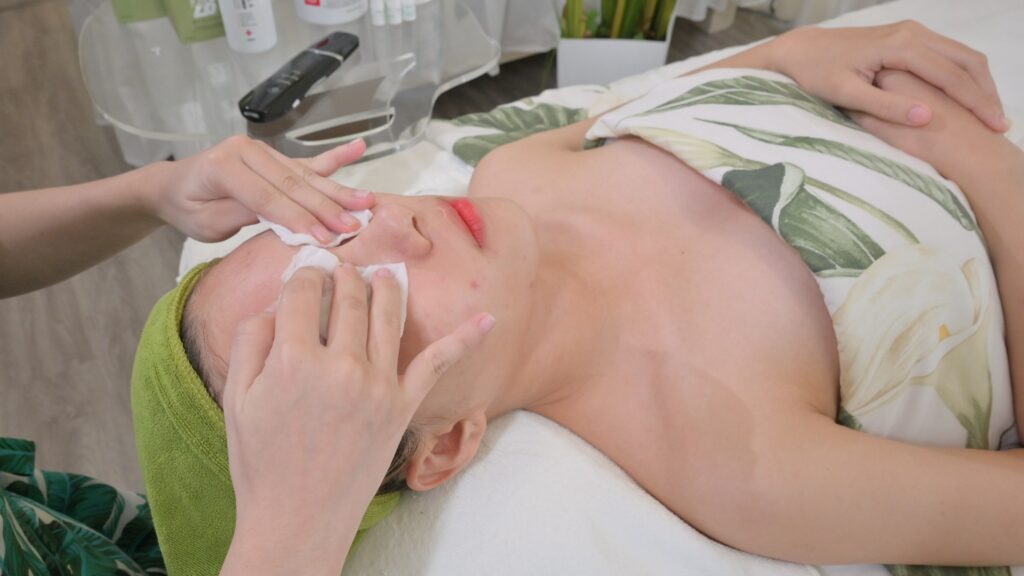
Note: PK102 (RF Needle hair) does not currently have its own photo folder — illustrations use general clinic environment images.
⑥ Who is a candidate — and who is NOT
This section matters more than the price table, so read it first.
Suitable to begin: androgenetic alopecia on a scalp with no active disease; postpartum, post-stress or post-illness shedding — often responsive, because the follicles are resting rather than atrophied; thinning and fine hair where the goal is thicker shafts; and long-standing androgenetic alopecia where follicles are miniaturised but not yet gone, which needs multi-axis combination and patience.
NOT suitable now — see a specialist or treat something else first:
- Suspected scalp fungal infection: localised patches of hair loss, scaling, inflammation, itching, hair broken off close to the scalp, sometimes with lymph node involvement. This is an infection requiring confirmed diagnosis and prescription antifungal treatment. Injecting nutrients into an infected scalp gets the order completely wrong and delays the treatment that would actually work.
- Actively flaring seborrhoeic dermatitis: red, greasy scalp with heavy dandruff and significant itch. Control the inflammation and sebum overproduction first.
- Active scalp psoriasis: thickened plaques with silvery scale and sharp borders, often beyond the hairline. An immune-mediated disease requiring long-term management by a dermatology specialist, not a treatment course. Microneedling over an active plaque is not something to do.
- Alopecia areata: round, smooth patches appearing rapidly. Immune-mediated, requiring separate medical assessment.
- Heavy diffuse shedding with systemic signs — weight loss, unusual fatigue, menstrual irregularity, thyroid changes, or a recently started medication. The hair loss is a signal; the first task is identifying the systemic cause, not injecting the scalp.
- Areas already completely bald, with shiny scalp and no visible follicular openings. If the follicles have fully atrophied, nothing here can wake up what is no longer there. We will say so directly at the examination rather than sell a course.
- A patient expecting visible growth within a few weeks. Moving a follicle from rest to a visible shaft is measured in months. If that is your precondition, we advise not starting.
⑧ Frequently asked questions
What is the difference between scalp fungal infection and seborrhoeic dermatitis?
Tinea capitis is a fungal infection producing inflammatory lesions, scaling and localised hair loss patches, requiring confirmed diagnosis and prescription antifungal treatment. Seborrhoeic dermatitis is inflammation on a background of sebum overproduction — heavy dandruff, redness, greasiness, itch — managed by controlling inflammation and sebum. Different diseases, different drugs, which is why self-medicating is risky.
Does scalp fungal infection cause permanent hair loss?
Hair loss in tinea capitis is a consequence of inflammatory and infectious damage, so recovery depends heavily on how early it is identified and treated. That is why the first step is a diagnostic consultation, not a search for a growth-stimulation course.
How is scalp psoriasis treated?
Psoriasis is an immune-mediated inflammatory disease requiring long-term management by a dermatology specialist, not resolution through an aesthetic course. While a plaque is active, microneedling over that area is not indicated.
Hair loss and balding in Vietnam — which type is most common?
Androgenetic alopecia, in both men and women. The mechanism is 5-alpha reductase converting testosterone to DHT; DHT binds androgen receptors at the follicle and causes atrophy, so each successive cycle produces a finer shaft.
Is there any way to make hair grow fast?
Not in the sense advertising uses the word. Bringing a follicle from rest to a visible shaft takes months. What can be influenced is shortening the resting phase, extending the growth phase, and thickening new shafts — not compressing the biological cycle.
I have heavy dandruff and I’m shedding. Should I book a follicle-stimulation course?
Not yet. Heavy dandruff with a greasy, itchy scalp suggests the base is inflamed. Control the inflammation first and restore the follicle second.
Does postpartum shedding need treatment?
It falls under telogen effluvium — many follicles shift into rest after an event. The follicles are usually not atrophied, so this group often responds well. Whether intervention is needed is decided by the physician after trichoscopic examination.
What is the difference between hair meso, exosome and biosome?
Meso booster supplies a nutrient and peptide complex. Exosome therapy uses nanoscale extracellular vesicles carrying growth factors and miRNA to reactivate the Wnt/β-catenin pathway and wake miniaturised follicles. Biosome is exosome therapy with a biological carrier system that preserves activity and improves penetration through the scalp’s thick epidermis.
RF Needle or MTS?
MTS is purely mechanical: opening micro-channels and triggering endogenous growth factor release. RF Needle adds radiofrequency heat at 1.0–2.5mm depth, which additionally breaks down fibrotic bands around the follicle. Where fibrosis is pronounced, that thermal component is what MTS cannot replace.
Is Celluma LED painful, and does it require downtime?
No. It is a non-invasive light therapy that generates no tissue-destroying heat, emits no ultraviolet and requires no anaesthetic. It is also commonly used immediately after invasive procedures to calm the scalp and reduce redness.
Where can I get hair loss and scalp disease treatment in Can Tho?
Phòng khám Chuyên khoa Da liễu Lona Skin Lab in Can Tho, Vietnam. The address, exactly as registered: T2, đường Đinh Công Tráng, phường Ninh Kiều, TP. Cần Thơ. Medical director: MSc. Dr. Le Thi Thao Vy, specialist in Dermatology. Operating licence: 735/CT-GPHĐ. Advertising licence: 4770/XNQC-SYT. Hotline: 0777 679 902 · 0932 927 723. The first visit is a trichoscopic examination to establish whether your hair loss is follicular or caused by underlying scalp disease.
⑩ Home care between sessions
In this cluster the home component carries proportionally more weight than in any other, because follicles respond over long cycles. Two product groups are commonly prescribed, both on lona.vn: a scalp cleansing and balancing range — regulating sebum, reducing greasiness, supporting dandruff control, and determining whether the base is clean enough for follicles to anchor; and at-home follicle nourishment serums for maintenance between sessions, which matter most for patients living far away or abroad. If you are being treated for a scalp disease with prescription medication, the medication comes first and care products follow it, on the physician’s instruction.
⑨ Message us
The question worth asking first is not “which treatment should I book”. It is “is my hair loss follicular, or caused by an underlying scalp disease?” That can be asked from abroad, and answering it correctly saves both money and time.
- Messenger: https://m.me/lonaskinlab.vn?ref=cum-04
- Zalo: https://zalo.me/4428027389339512399
- Hotline: 0777 679 902
- From abroad: WhatsApp +84 777 679 902 · Contact@lona.vn
Send photographs of the scalp at the area of heaviest loss and along the hairline in advance, with a description of dandruff, itching and any medications you take.
Phòng khám Chuyên khoa Da liễu Lona Skin Lab (Lona Skin Lab Specialist Dermatology Clinic) T2, đường Đinh Công Tráng, phường Ninh Kiều, TP. Cần Thơ. Hotline: 0777 679 902 · 0932 927 723 Operating licence: 735/CT-GPHĐ Advertising licence: 4770/XNQC-SYT Medical director: MSc. Dr. Le Thi Thao Vy — specialist in Dermatology
Chú ý: Nội dung bài viết chỉ mang tính chất tham khảo, không thay thế cho việc chẩn đoán hoặc điều trị y khoa. Vui lòng tham khảo ý kiến bác sĩ trước khi áp dụng bất kỳ phương pháp nào. Xem thêm