

Most people searching for “high-tech skin rejuvenation” open with the wrong question: which machine is best? The right question is: which anatomical layer of my skin is damaged, and what form of energy actually reaches that layer?
This article is not a product page for one device. It is a map. It starts from what you see in the mirror, works down to the layer where that problem actually sits, and only then names the technology group capable of reaching it. If you are reading this from the US, Australia or Canada and planning a trip home, section 2 is written for you and comes before the clinical detail on purpose — scheduling decisions have to be made before treatment decisions.
1. Which layer of your skin is actually damaged
Skin does not age or scar in one way. It fails across four independent layers, and all four can coexist on one face at completely different severities. This is why two people who are both 42 need two protocols that look nothing alike.
The colour layer — pigment disorders. Melanocytes produce melanin and push it up into the epidermis. When that process loses control, pigment settles as freckles, solar lentigines and café-au-lait macules in the superficial layer; or it drops deeper, into the dermis, as nevus of Ota, Hori’s nevus and deep-rooted melasma (nám chân sâu). Those two depths require two different wavelengths — the single most skipped point in most marketing copy. Chronic melasma is a step more complex again: it is not only surface melanin, but also damage to the epidermal basement membrane, elastotic degeneration of the dermis, and increased vascularity feeding the pigmented patch.
The texture layer — surface and matrix. Boxcar scars, rolling scars and icepick scars result from fibrotic bands tethering the skin from below plus a deficit of extracellular matrix. Enlarged pores are follicular ostia that have lost the collagen network around them, compounded by overactive sebaceous glands. Crepey skin is an atrophic dermis that has lost connective-fibre density.
The structural layer — SMAS and retaining ligaments. This is the deepest layer, roughly 4.5mm down. The superficial muscular aponeurotic system (SMAS) slackens, retaining ligaments weaken, the malar fat pad descends to create a deep nasolabial fold and marionette lines, and jowls interrupt the jawline. No topical product and no surface procedure reaches this layer.
The volume layer — localised fat. The submental fat pad, sagging cheek fat, infraorbital fat herniation. This is excess volume, not laxity — and confusing the two is the most common reason a patient is disappointed after spending a large sum.
A severely aged face at 50 usually fails on all four layers at once. A 28-year-old presenting with “dull skin and large pores” fails only on the texture layer — and if she is sold a deep lifting package, that is money spent in the wrong place.
2. Travelling in for treatment: how to schedule the trip
Three distances, three different problems.
From overseas — the group that needs the most planning. The biggest risk is not the procedure. It is flying home and only then running into something. Three rules:
1. Lona recommends leaving at least 2 weeks between a procedure and your flight. This is the clinic’s general recommendation; the specific interval for your procedure is set by your treating doctor, because an ablative fractional laser and a non-ablative toning session have very different recovery curves. 2. Group your procedures into a single block. Rather than scattering them, let the doctor sequence the interventions across the time you are in Vietnam. Some combinations must run in a fixed order — pigment work before structural work, for instance. 3. Get a remote consultation before you fly. Do not discover on arrival that you are not a candidate. Send photos and a description of your condition via WhatsApp +84 777 679 902, Zalo, or Contact@lona.vn and get a direction first — including when the honest answer is “this case should wait.”
From Ho Chi Minh City to Can Tho. If you are spending a weekend day on the drive, make the day count: message ahead with photos so the doctor has a preliminary picture, then consult and treat in the same visit instead of splitting it across two trips. For protocols that need several sessions, ask at the first visit about the interval between sessions so you can plan the travel yourself.
From the Mekong Delta provinces to Can Tho. Every procedure in this article is a same-day intervention. The no-peel group — Laser Toning, HIFU Glow, nano RF microneedling — has essentially zero downtime; the skin is pink for a few hours and you can travel home the same day. For procedures that produce micro-crusting — needle RF microneedling or fractional CO2 — budget an extra 1–2 days of redness and fine crusting when you schedule, particularly if you have to see people the next day.
Currency note for all prices in this article. Figures below are in Vietnamese dong (VND). For reference only, this article uses a rounded rate of 1 USD ≈ 25,600 VND (so 10,000,000đ ≈ 391 USD). These conversions are approximate, for reference only — check the live rate before budgeting, and treat the VND figure as the actual quoted price.
3. A full map of the available approaches — including what Lona does not do
The “offered” and “not in the catalogue” labels below reflect the published service catalogue as of October 2026. If you need a direction that is not listed, ask — if it is not something done here, you will be told so directly and pointed somewhere suitable.
Five energy-based or mechanical directions exist in this market. All five are listed, including the ones outside our menu.
1. Non-ablative selective photothermolysis (Nd:YAG, 1064nm / 532nm). Mechanism: energy is absorbed selectively by melanin, haemoglobin and water, destroying the target without harming surrounding healthy tissue. The 1064nm wavelength penetrates to the dermis and fragments melanin particles into micro-debris that macrophages clear; 532nm is strongly absorbed in the epidermis and fades freckles and lentigines. In microsecond modes (Genesis, long-pulse) the same platform deposits gentle bulk heat in the papillary dermis to activate fibroblasts. Suits: pigment disorders at any depth, post-inflammatory erythema, telangiectasia, dull skin. Limits: it does not lift descended structure and does not fill deep atrophic scars.
2. Ablative fractional laser (fractional CO2, 10,600nm). Mechanism: creates microscopic treatment zones (MTZs) deep into the dermis, selectively vaporising aged tissue while leaving healthy tissue between columns to drive rapid healing. Suits: boxcar and icepick scars, planing down hard scar shoulders, periorbital syringomas, skin tags, seborrhoeic keratoses, full surface resurfacing. Limits: micro-crusting and real downtime, and depth must be controlled tightly on darker skin.
3. RF microneedling (vi kim sóng vô tuyến). Mechanism: combines micro-mechanical injury from a needle array with radiofrequency heat emitted at the needle tips, at depths of 0.5–4.0mm. Because heat is delivered straight into the target dermis while the epidermal barrier above is preserved, the risk of post-inflammatory hyperpigmentation (PIH) drops to a minimum — which matters a great deal for Fitzpatrick III–IV Asian skin. Suits: atrophic scars, enlarged pores, oily skin, striae, fine static lines. Limits: the deep-needle version is invasive, with 1–2 days of redness and fine micro-crusting.
4. HIFU — high-intensity focused ultrasound. Mechanism: focuses ultrasound energy into thermal coagulation points (TCPs) at a preset depth, reaching 65–70°C at the 4.5mm SMAS plane, contracting aged collagen fibres immediately and then triggering neocollagenesis over the following 2–3 months. The 3.0mm and 1.5–2.0mm cartridges cover the deep and superficial dermis. Suits: structural laxity, a blurred jawline, submental fullness, neck laxity. Limits: it does nothing for pigment, nothing for atrophic scars, and over-treating a face that still has good volume risks hollowing the cheeks — removing the fat padding that is an asset of a young face.
5. Mechanical and surgical intervention. Surgical face-lift, open liposuction, thread lifting. This direction gives the strongest result in severe descent, but comes with anaesthesia, scars and extended recovery.
What Lona Skin Lab does not do in this category. Our high-technology menu contains 14 services across exactly three groups: HIFU, RF microneedling and laser. We do not perform surgical face-lifts, we do not perform open liposuction, and we do not place lifting threads. If, after examining you, the doctor judges that your degree of descent has passed what non-surgical intervention can address, you will be told that directly and advised toward the surgical route — rather than sold a high-density HIFU package and left disappointed three months later.
One note on manual lifting massage (massage da mặt nâng cơ): it is a pleasant treatment that supports lymphatic drainage and muscle relaxation, but it acts at the surface and cannot create thermal coagulation points at the SMAS plane. It does not replace energy-based intervention, and anywhere that claims otherwise is overstating.
4. Which direction Lona takes, and why
We work with three non-invasive or minimally invasive technology groups, following one consistent logic: prioritise Asian skin, and prioritise control of post-inflammatory hyperpigmentation.
For the colour layer, we use Nd:YAG rather than shorter-wavelength platforms, because 1064nm penetrates deeply and is less heat-trapped by epidermal melanin, minimising the risk of thermal burn and darkening on the Fitzpatrick III–IV skin common in Vietnamese patients.
For the texture layer, we put RF microneedling in the front line instead of defaulting to ablative laser for every scar case, because RF preserves the epidermal barrier and cuts recovery to 1–2 days. Fractional CO2 is kept for the indications only ablation can solve.
For the structural layer, we band HIFU by shot density tied to the real degree of ageing rather than selling one generic package: 200–250 shots for patients who only need superficial tightening, 600–700 for mild ageing, 800–900 for moderate ageing, 1000–1200 for severe ageing. The reasoning is concrete: below 400 shots, thermal coagulation points are usually too sparse to form a continuous grid across the whole face, so the result is faint or fades fast; conversely, over-treating a face that still has volume tightens the muscle layer but costs you the fat padding.
For the volume layer, localised fat is handled by a separate service group and is not covered here.
5. Lookup table: your problem → the matching technology
Read the first column first. Find the row that describes what you actually see, then read across to the technology.
| Problem to solve | Service | Brand / product used | Invasive | Area | Listed price range |
|---|---|---|---|---|---|
| Melasma, freckles, lentigines, dull tone, post-acne erythema | PK59 — Laser Toning | Nd:YAG laser | No | Face | from 2,500,000đ (≈98 USD) |
| Both pigmentation and large pores, poor skin firmness | PK58 — RF Needle Toning | RF Needle + Nd:YAG laser | Yes | Face | from 4,500,000đ (≈176 USD) |
| Lip pigmentation, Fordyce spots, lip lines | PK60 — Lip rejuvenation laser | Fractional CO2 laser | No* | Lips | from 2,000,000đ (≈78 USD) |
| Atrophic acne scars, large pores, collagen-depleted skin | PK56 — RF Needle basic | Needle RF microneedling | Yes | Face | from 3,000,000đ (≈117 USD) |
| Rough, uneven, large-pored skin — zero downtime wanted | PK57 — RF Needle nano | Nano RF microneedling | No | Face | from 3,000,000đ (≈117 USD) |
| Dry skin, no bounce or glow, fine static lines | PK51 — HIFU Glow | HIFU 200–250 shots, 2mm depth | No | Face | from 6,000,000đ (≈234 USD) |
| Submental fullness, wanting a V-shape | PK18 — HIFU Submental | HIFU 4.5mm, 300–400 shots | No | Face | from 10,000,000đ (≈391 USD) |
| Localised laxity in one specific zone | PK52 — Mono HIFU | HIFU 4.5mm, 400 shots per zone | No | Face | from 10,000,000đ (≈391 USD) |
| Infraorbital fat, periorbital lines, mild lid ptosis | PK53 — HIFU Eyes | HIFU ultra-fine cartridges | No | Eyes | from 8,000,000đ (≈312 USD) |
| Forehead lines | PK54 — HIFU Forehead | HIFU forehead protocol | No | Forehead | from 10,000,000đ (≈391 USD) |
| Neck laxity, horizontal neck rings | PK55 — HIFU Neck | HIFU neck protocol | No | Neck | from 8,000,000đ (≈312 USD) |
| Mild full-face ageing (30+): jawline starting to blur | PK48 — HIFU 30+ | HIFU 600–700 shots, 4.5mm | No | Face | 15,000,000đ – 35,000,000đ (≈600–1,400 USD) |
| Moderate full-face ageing (40+): jowls, deep nasolabial folds | PK49 — HIFU 40+ | HIFU 800–900 shots, 4.5mm | No | Face | not listed |
| Severe full-face ageing (50+): broken jawline, neck banding | PK50 — HIFU 50+ | HIFU 1000–1200 shots, 4.5mm | No | Face | not listed |
All figures above are listed prices, not including period-specific offers, and subject to adjustment based on each patient’s actual condition. USD figures are approximate, for reference only, at a rounded rate of 1 USD ≈ 25,600 VND. The two services marked “not listed” require an in-person examination before a quote can be given — shot density for a severe case can only be set once the real degree of descent has been assessed.
\PK60 is classified “non-invasive” in the service list because no incision is made; fractional CO2 is nonetheless an ablative fractional technology and does produce micro-crusting afterwards. Build that recovery time into your schedule.*
6. What a session actually involves
The three technology groups follow three different protocols. These are the steps as actually performed.
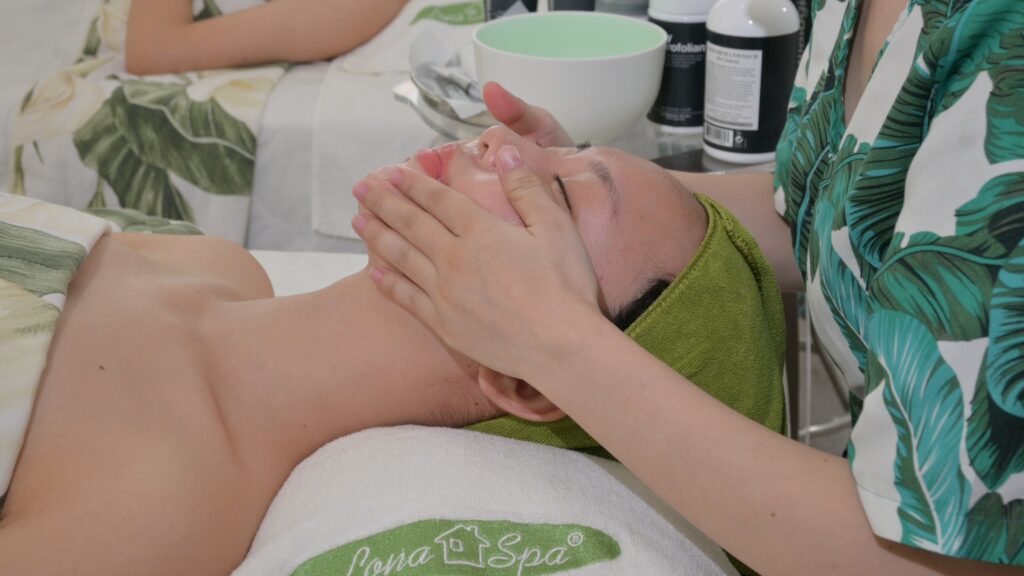
HIFU protocol (PK18 and the regional HIFU services): cleanse — makeup removal, wash, exfoliation → decongest — steam, acne softening mask, oil extraction → acne management — extraction, antisepsis, disinfection → soothing mask to reduce inflammation → topical anaesthetic on the treatment area → the HIFU procedure → recovery mask and Celluma LED → moisturiser and sunscreen → scalp massage to finish.
RF Needle protocol (PK56, PK57): cleanse → decongest → acne management → soothing mask → topical anaesthetic → the RF Needle procedure → recovery mask and Celluma LED → moisturiser and sunscreen → scalp massage.
Laser Toning protocol (PK59): cleanse → decongest → acne management → soothing mask → Laser Toning with the Nd:YAG 1064nm platform → panthenol soothing application → recovery mask and Celluma LED → moisturiser and sunscreen → scalp massage.
Combined two-layer protocol (PK58): cleanse → decongest → acne management → soothing mask → Laser Toning with the Nd:YAG 1064nm platform → panthenol soothing application → topical anaesthetic → the RF Needle procedure → recovery mask and Celluma LED → moisturiser and sunscreen → scalp massage.
Note the common pattern: the energy step is never first. The skin is cleansed, decongested and calmed beforehand — an acutely inflamed surface responds to heat unpredictably.
7. Who is a candidate — and who should wait
Clear candidates: people with one identifiable problem in one specific layer — atrophic scars on otherwise stable skin, malar freckling, a jawline starting to lose definition in the early thirties, or horizontal neck rings from looking down at a phone. Patients aged 25–35 with early ageing who want to maintain elasticity also respond well to superficial-layer intervention.
Who should not proceed yet:
- Active inflammatory or pustular acne. Delivering heat into acutely inflamed skin adds fuel to the fire. Stabilise the inflammation first, treat with technology after.
- Melasma in an active flare, or skin that is red and stinging from a recent abrasive product or peel. The barrier is already compromised; intervening now invites post-inflammatory hyperpigmentation.
- A face that still has good volume and healthy fat padding, but wants “HIFU to slim it down.” This is the group at highest risk of hollowed cheeks. Your issue may be contour, not laxity.
- Expecting a lift when the real problem is excess fat, or the reverse. The two look similar in a mirror and need entirely different approaches. Only examination and skin analysis separate them.
- Descent that has already reached the surgical threshold. It is better said plainly: high-density HIFU does not substitute for a face-lift in this group.
See a different specialist first: anyone with a skin lesion of unclear nature, a mole changing in size or colour, or an active systemic dermatological condition. Aesthetics comes after diagnosis, never before it.
8. Frequently asked questions
1. What are the main laser categories and their applications in dermatology?
Two large groups. Non-ablative lasers (Nd:YAG) target melanin and haemoglobin selectively and leave the surface intact. Ablative fractional lasers (fractional CO2) vaporise tissue in microscopic columns to resurface. The first group addresses colour; the second addresses texture.
2. How does laser treatment for melasma and freckles work?
Laser energy is absorbed selectively by melanin particles and fragments them into micro-debris that macrophages clear. Freckles and lentigines sit superficially and respond to 532nm; deep-rooted melasma, nevus of Ota and Hori’s nevus sit in the dermis and need the deeper-penetrating 1064nm.
3. When is fractional CO2 laser the right choice?
Mainly for texture problems: boxcar and icepick scars, hard raised scar shoulders, periorbital syringomas, skin tags, seborrhoeic keratoses. It is an ablative technology, so expect micro-crusting and tight depth control on darker skin.
4. What does “non-surgical face lifting” actually mean?
A group of interventions that deposit heat at depth to contract existing collagen and trigger new collagen synthesis — typically HIFU acting on the SMAS plane at 4.5mm. It improves laxity, but it does not excise redundant skin the way surgery does.
5. Can lifting facial massage replace energy-based lifting?
No. Massage supports drainage, relaxes muscle and feels good, but it acts at the surface and cannot create thermal coagulation points at the SMAS plane. The two are complementary, not interchangeable.
6. Where should high-tech skin rejuvenation start?
With a layer diagnosis, not with a device. Skin analysis and examination establish whether your problem sits in the colour, texture, structural or volume layer — only then do you choose the technology that reaches that layer.
7. How many HIFU shots are enough?
It depends on the real degree of ageing, not the age on your passport. Below 400 shots there are usually too few coagulation points to form a continuous grid across the face; conversely, over-treating a face with good volume can cost you fat padding. This is why shot density is set by the doctor after examination.
8. Are these technologies safe on Asian skin, and how do RF and CO2 compare for scars?
Fitzpatrick III–IV skin is more prone to post-inflammatory hyperpigmentation, so wavelength choice and barrier preservation are the priorities. RF microneedling delivers heat into the dermis while preserving the epidermal barrier, so PIH risk is lower and recovery is about 1–2 days; CO2 laser ablates the surface, which is powerful for planing hard scar shoulders but needs longer recovery.
9. Where can I get laser, scar or lifting treatment in Can Tho, Vietnam?
At Phòng khám Chuyên khoa Da liễu Lona Skin Lab (Lona Skin Lab Dermatology Specialist Clinic) in Can Tho — T2, đường Đinh Công Tráng, phường Ninh Kiều, TP. Cần Thơ. The clinic runs all three technology groups — laser, RF microneedling and HIFU — so the choice of direction follows the skin analysis rather than being limited by whichever device is on hand.
10. How long before I see results, and will I need time off?
Thermal contraction shows on the treatment table, but the part that matters more is neocollagenesis, which typically peaks 2–3 months after HIFU. Laser Toning, HIFU Glow and nano RF microneedling essentially require no downtime; needle RF microneedling needs 1–2 days; fractional CO2 needs additional time for crusting to shed.
9. Home care after treatment
The part that decides your outcome is not on the treatment table — it is the following 14 days. Three non-negotiables: strict sun protection (every thermal intervention leaves skin UV-sensitive, and this is the number one reason melasma returns after laser), barrier repair with a fragrance-free soothing product, and pausing abrasive actives — retinoids, high-strength AHA/BHA — until your doctor clears them.
The sunscreen range and the post-procedure soothing and repair group are available at lona.vn. If you are travelling and will not be back, ask during your session so you can take the right products home for the recovery window.
10. Message us
No lookup table replaces a skin analysis. If you have read this far and are still choosing between two technology groups, send photos and a description of your condition — a dermatologist and a skin-analysis technician will tell you which layer your problem sits in and which direction makes sense.
- Messenger: https://m.me/lonaskinlab.vn?ref=cum-10
- Zalo: https://zalo.me/4428027389339512399
- Hotline: 0777 679 902
- WhatsApp: +84 777 679 902 · Email: Contact@lona.vn
Phòng khám Chuyên khoa Da liễu Lona Skin Lab T2, đường Đinh Công Tráng, phường Ninh Kiều, TP. Cần Thơ. Hotline: 0777 679 902 · 0932 927 723 Operating licence: 735/CT-GPHĐ · Advertising licence: 4770/XNQC-SYT Medical director: ThS.BS Lê Thị Thảo Vy — Dermatology
Chú ý: Nội dung bài viết chỉ mang tính chất tham khảo, không thay thế cho việc chẩn đoán hoặc điều trị y khoa. Vui lòng tham khảo ý kiến bác sĩ trước khi áp dụng bất kỳ phương pháp nào. Xem thêm