

① Pigment disorders are not one condition — they are several that look alike
Skin colour comes from melanin, produced by melanocytes in the basal layer of the epidermis. A melanocyte packages melanin into melanosomes and hands them to surrounding keratinocytes, which carry the pigment upward as the skin turns over. The whole assembly line is governed by tyrosinase.
When that line runs too hot, or deposits pigment in the wrong layer, you get a pigment disorder — but “wrong” happens in several ways, and each demands a different intervention:
- Freckles and solar lentigines: superficial epidermal melanin, fairly well-defined, darkening after sun exposure. Because they sit shallow, they respond well to surface work.
- Superficial melasma: symmetrical brown patches across the cheekbones, forehead and nose bridge. The pigment is still epidermal, but melanocytes are in sustained hyperactivity driven by UV, hormonal fluctuation and low-grade inflammation.
- Deep-rooted melasma: a different problem entirely — see below.
- Post-inflammatory hyperpigmentation (PIH): melanin deposited after acne, a burn, or an over-aggressive procedure. Not melasma, but the aftermath of inflammation — it fades once the inflammatory driver is removed.
- Post-inflammatory erythema (PIE): not pigment at all, but residual vascular dilation. A brightening cream here treats the wrong target.
- Dull, uneven tone: a thickened photo-aged stratum corneum plus scattered pigment, rather than one discrete lesion.
Two mechanisms explain most treatment failures. First, chronic cheek melasma is typically accompanied by abnormal microvascular proliferation beneath the patch, which feeds the pigment-producing cells. Destroy the melanin without addressing that supply and the melasma returns — this is the line between temporary brightening and genuine control.
Second, the dermal-epidermal junction. When it is disrupted by prolonged inflammation, over-energetic laser, or long-term topical corticosteroids, melanin drops from the epidermis into the dermis and stays there. Superficial melasma becomes mixed, then deep. This is why a case mistreated for a year is harder than the same case was at the start.
Deep-rooted melasma (nám chân sâu)
Deep-rooted melasma, known in Vietnamese as nám đinh, sits close to the Hori-type dermal hyperpigmentation group. The defining feature is depth: the pigment has reached the dermis. Clinically it appears as brown-grey or blue-grey dots with fairly sharp edges, scattered rather than confluent, usually symmetrical across both cheekbones. Two consequences follow:
1. Every surface intervention is ineffective. Peeling exfoliates the stratum corneum — but the pigment is not there. Topicals stop at the epidermis. A patient peeled for deep-rooted melasma sees the surrounding skin brighten slightly while the dots remain exactly as they were. 2. You need a wavelength that reaches depth. Within the Nd:YAG family, 532nm is absorbed in the epidermis and only addresses superficial lesions; 1064nm has the penetration to reach the dermis — as required for deep-rooted melasma and for naevus of Ota, naevus of Ito and Becker’s naevus.
In practice this group needs more sessions, longer intervals, and someone willing to say plainly that it is not the kind of melasma that clears in one course.
Beard-area melasma (nám râu)
“Beard melasma” names a distribution, not a separate mechanism: upper lip, perioral area, chin, sometimes the jawline, in both men and women. It is misread in two opposite directions:
- Mistaken for true melasma when it is PIH. In men the moustache area endures repeated trauma from shaving plus low-grade chronic folliculitis — the textbook setup for post-inflammatory pigmentation. If so, the correct sequence is to control inflammation and fix the shaving routine first, not to go straight to laser.
- Mistaken for ordinary post-acne darkening when it is genuinely melasma. The perioral area is hormonally responsive too, and melasma here can be mixed superficial-and-deep.
Anatomy compounds it: the region moves constantly, the skin is thinner than the cheek, and follicular density is high. Treatment energy must be more conservative, and the PIH risk after any procedure is higher here. Beard-area melasma is hard not because the biology is exotic, but because the distinction must be made correctly, under skin analysis, before anything is done.
⑦ Planning the trip: for patients travelling from abroad
If you are reading this from the United States, Australia or Canada, the scheduling question comes before the method question — so we answer it first.
The core recommendation: Lona advises scheduling treatment at least 2 weeks before your flight. This is the clinic’s general recommendation; the specific interval for your procedures is given directly by your treating physician, because recovery differs substantially between procedure groups.
Why this matters more for pigment work than for most aesthetic treatments: Fractional CO2 procedures involve a genuine crusting-and-peeling phase requiring correct aftercare. Nd:YAG laser and mesotherapy leave the skin photosensitive and requiring strict sun avoidance. Boarding a flight and arriving where you have no follow-up access, during the window when post-inflammatory hyperpigmentation is most likely, is the most common way a good result is lost.
Three practical rules for overseas patients:
1. Consult remotely before you fly. Send photographs, describe your treatment history, and be specific about everything you have used — including what patients are reluctant to mention, such as compounded “mixed creams” or long-term topical corticosteroids. That information can change the whole plan. Channels: WhatsApp +84 777 679 902 · Zalo · Contact@lona.vn. 2. Consolidate procedures into a single visit. Long-distance patients are advised to group procedures into one treatment block rather than spreading them across trips. Use the first skin-analysis consultation to build the plan for the whole course — service sequence and intervals — so you can arrange your own travel. 3. Leave room for a follow-up before departure, when the physician confirms the skin is stable and hands over the home-care protocol.
One thing worth hearing in advance: for deep-rooted melasma, a single trip home is not enough for the full course. The sensible use of one trip is assessment, protocol design, completing what can be completed, then maintaining with the home protocol and remote follow-up between trips.
Shorter distances, for context. Patients from the Mekong Delta provinces should allow a full day per appointment — the protocol in section ⑤ is a complete sequence, not a fifteen-minute stop — and the detail that matters most is the journey home: after an invasive procedure, physical sun protection (wide-brimmed hat, mask, sunglasses) matters more than the sunscreen layer. Patients travelling down from Ho Chi Minh City typically give up one weekend day, and the same consolidation advice applies.
② The method map — including the approaches we do not offer
The “offered” and “not in the catalogue” labels below reflect the published service catalogue as of October 2026. If you need a direction that is not listed, ask — if it is not something done here, you will be told so directly and pointed somewhere suitable.
1. Topicals and prescription oral therapy. Local tyrosinase inhibition, reduced melanosome transfer, antioxidant action. Suits early superficial melasma and mild PIH, and belongs in every protocol as the foundation. Limitation: actives must cross the stratum corneum, so the concentration reaching the target layer is far below the concentration in the bottle; dermal pigment is essentially out of reach.
2. Chemical peeling. Organic acids break the desmosomal bonds between melanin-laden corneocytes, accelerating turnover, while certain acids block tyrosinase. Suits superficial melasma, lentigines, shallow freckles, post-acne marks, dull hyperkeratotic skin. Limitation: it does not reach dermal pigment, and high-concentration peeling on Asian skin types carries a real PIH risk if the inflammatory response is not controlled.
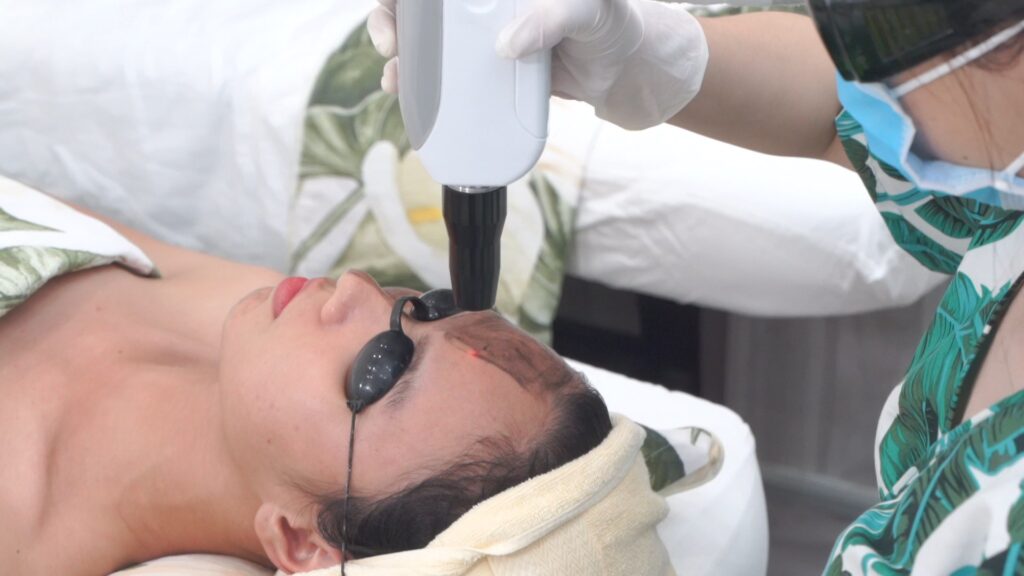
3. Nd:YAG laser (selective photothermolysis). Ultra-short pulses are selectively absorbed by melanin, producing a photoacoustic effect that fragments pigment into ultrafine particles for macrophage clearance without damaging healthy tissue. 532nm for superficial layers, 1064nm for depth, low-fluence 1064nm toning to manage melasma without killing melanocytes. Suits nearly the whole pigment spectrum. Limitation: it depends entirely on the operator — the wrong fluence either does nothing, or causes rebound hyperpigmentation and punctate hypopigmentation.
4. Mesotherapy. Delivers pigment-inhibiting and antioxidant actives directly into the superficial dermis, where melanocytes and the basement membrane sit, bypassing the epidermal barrier. Suits patch melasma, mixed melasma, pigmented skin on a compromised base, and cases where the vascular supply must be addressed. Limitation: invasive, requires strict asepsis, and is not a one-session solution.
5. Fractional CO2 laser. The 10,600nm wavelength vaporises intracellular water in microcolumns, resurfacing the epidermis and triggering dermal collagen induction. Suits hyperkeratotic skin, superficial photo-induced pigment, rough texture, enlarged pores, post-acne marks; the ablative mode removes benign proliferative lesions. Limitation: this is not the primary method for melasma — thermal energy is itself a melanocyte stimulus, and used on the wrong indication over active melasma it can darken the condition.
6. What Lona does NOT do — and why.
- No skin-whitening baths, whitening infusions, or any service selling a change in overall skin colour. The goal of pigment treatment is to return skin to its own base tone, evenly — not to change the tone. “Several shades lighter” sells an expectation that skin biology does not supply.
- No high-concentration peeling to “clear melasma in one session.” On Asian skin types that trade buys one bright week at the cost of many months of post-inflammatory hyperpigmentation.
- No ablative or high-fluence laser as the first step on inflamed, actively flaring melasma. Calm the inflammation and strengthen the base first, fragment the pigment second. Reversing that order is the most common cause of melasma that worsens the more it is treated.
- No aesthetic treatment for pigmented lesions of unclear nature. A lesion changing size, with uneven colour, an irregular border, or that bleeds or ulcerates requires specialist dermatological assessment — not a laser pass to fade it.
③ Which direction Lona takes, and why
The clinic works on multi-layer combination therapy, prioritising the skin base over speed, along three parallel axes.
Suppression at source — pigment mesotherapy. Purpose: deliver brightening and pigment-correcting actives into the correct target layer by injection. Reason: tranexamic acid, glutathione, vitamin C, niacinamide, arbutin, kojic acid and biomimetic peptides inactivate tyrosinase, cut the UV- and hormone-driven stimulation signal to melanocytes, and block melanosome transfer. Tranexamic acid additionally constricts and reduces the density of the abnormal microvasculature beneath the patch — attacking the supply, not just the pigment. A further advantage for thin skin: mesotherapy involves no mechanical ablation and no thermal destruction, so it does not thin the skin.
Pigment fragmentation — Nd:YAG laser. Reason for choosing Nd:YAG: it lets you select the target layer by wavelength — 532nm for freckles, solar lentigines and café-au-lait marks; 1064nm for deep-rooted melasma, naevus of Ota, naevus of Ito and Becker’s naevus; low-fluence 1064nm toning to break up melanosomes without destroying melanocytes, minimising rebound risk.
Reinforcing the base — exosomes, PN/PDRN. Reason: a disrupted basement membrane is the mechanism by which superficial melasma becomes deep melasma. These biologics repair the junction, suppress chronic micro-inflammation to return melanocytes to rest, and thicken the dermis so the skin tolerates actives without generating PIH. For thin erythematous or corticosteroid-damaged skin, this axis comes first, not as an add-on.
In practice mesotherapy is alternated with laser toning or gentle peeling — one fragmenting surface pigment, the other suppressing production underneath. All Fractional CO2 procedures are performed with the physician personally examining the skin and calibrating microcolumn density, depth and pulse energy per anatomical region, with biologic therapy combined immediately afterward to shorten downtime.
④ Comparison of all 12 services in the pigment cluster
| Service | Brand / product | Invasive | Area | Listed price |
|---|---|---|---|---|
| PK77 — Pigment mesotherapy (brightening) | Mesoestetic | Yes | Face | from 4,000,000 |
| PK78 — Pigment mesotherapy (combination) | Exosome + brightening | Yes | Face | from 12,000,000 |
| PK79 — Pigment mesotherapy (exosome) | Exocode | Yes | Face | from 8,000,000 |
| PK80 — Periocular booster mesotherapy | Rejuran Eyes · Nucleofill · Jalupro I | Yes | Face (periocular) | from 4,000,000 |
| PK81 — Brightening chemical peel | Synergy · Celestetic · Larimedical · Mediderma | No | Face | from 1,950,000 |
| PK82 — Spot laser, half face | Nd:YAG laser | Yes | Face (half) | from 2,000,000 |
| PK83 — Spot laser, full face | Nd:YAG laser | Yes | Face | from 3,000,000 |
| PK84 — Spectra toning | Nd:YAG laser | No | Face | from 2,500,000 |
| PK85 — Melasma laser | Nd:YAG laser | Yes | Face | from 3,000,000 |
| PK86 — Fractional laser lesion removal | Fractional CO2 laser | Yes | Face | from 3,000,000 |
| PK87 — Fractional Recovery | Fractional CO2 laser | Yes | Face | from 2,500,000 |
| PK88 — Fractional Peeling | Fractional CO2 laser | — | Face | from 3,500,000 |
Every figure above is a listed price. It does not include any seasonal offer, and it is adjusted according to each patient’s specific condition. Session count and service combination are determined by the physician after skin analysis; there is no fixed package applied to everyone.
Currency conversion — approximate, for reference only. At a reference rate of 1 USD ≈ 25,600 VND (used purely for orientation; your actual bank or card rate will differ): 1,950,000 VND ≈ 60 USD · 2,000,000 ≈ 80 · 2,500,000 ≈ 100 · 3,000,000 ≈ 120 · 3,500,000 ≈ 140 · 4,000,000 ≈ 160 · 8,000,000 ≈ 320 · 12,000,000 ≈ 480. Indicative only; not a quotation.
Three notes on reading the table. PK82 and PK83 differ only in treated area, so a patient with a lesion confined to one side need not pay for full-face coverage. PK84 is recorded as non-invasive because it is the low-fluence toning mode, distinct from the spot mode in PK82/PK83. PK86 is not a melasma service — its purpose is removal of benign proliferative lesions (naevi, syringoma, sebaceous gland tumours, warts, actinic keratosis); it sits in this cluster because patients who come in about “brown marks” very frequently also carry naevi and seborrhoeic keratoses, which require entirely different handling.
⑤ The step-by-step protocol
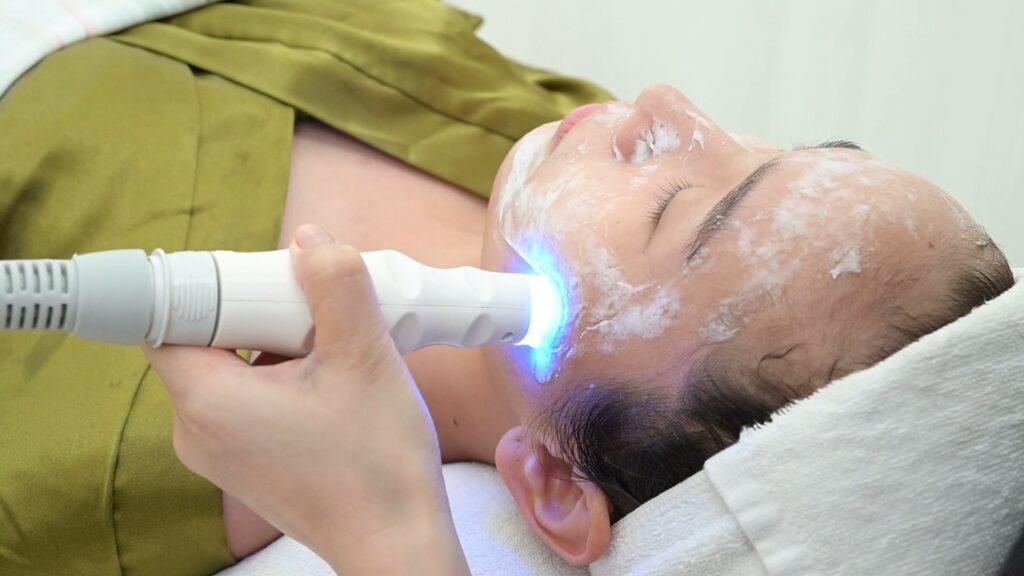
Mesotherapy (PK77, PK78, PK79, PK80): 1. Cleansing: makeup removal, face wash, exfoliation — 2. Decongestion: steaming, acne-softening compress, oil extraction — 3. Acne handling: comedone extraction, antisepsis, disinfection — 4. Soothing mask to reduce swelling and inflammation — 5. Topical anaesthetic on the treatment area — 6. Mesotherapy injection — 7. Massage, cold electrophoresis to calm the skin — 8. Mask plus Celluma LED recovery — 9. Moisturiser + sunscreen — 10. Head massage, a little relaxation to finish.
Chemical peel (PK81): 1. Cleansing: makeup removal, face wash — 2. Decongestion: steaming, acne-softening compress, oil extraction — 3. Comedone clearance (for acne peels) — 4. Peel performed as indicated — 5. Mask plus Celluma LED recovery — 6. Skin calming, recovery product applied — 7. Post-treatment sunscreen — 8. Head massage, a little relaxation to finish.
Nd:YAG laser (PK82, PK83, PK84, PK85): 1. Cleansing: makeup removal, face wash, exfoliation — 2. Decongestion: steaming, acne-softening compress, oil extraction — 3. Acne handling: comedone extraction, antisepsis, disinfection — 4. Soothing mask to reduce swelling and inflammation — 5. Laser toning with the Nd:YAG 1064nm laser — 6. Panthenol compress to calm the skin — 7. Mask plus Celluma LED recovery — 8. Moisturiser + sunscreen — 9. Head massage, a little relaxation to finish.
Fractional CO2 (PK86, PK87, PK88): 1. Cleansing: makeup removal, face wash, exfoliation — 2. Decongestion: steaming, acne-softening compress, oil extraction — 3. Acne handling: comedone extraction, antisepsis, disinfection — 4. Soothing mask to reduce swelling and inflammation — 5. Topical anaesthetic on the treatment area — 6. Fractional CO2 laser procedure — 7. Cold electrophoresis to calm the skin — 8. Mask plus Celluma LED recovery — 9. Moisturiser + sunscreen — 10. Head massage, a little relaxation to finish.
⑥ Who is a candidate — and who should not start now
Suitable to begin: superficial or mixed melasma, freckles and solar lentigines on stable, non-inflamed skin; post-acne pigmentation once the inflammatory acne has resolved; deep-rooted melasma, provided the patient accepts a long multi-session course at physician-set intervals; pigmented skin on a thin base — still treatable, but starting from base reinforcement rather than laser.
Should not start now:
- Active inflammatory acne. Intervening on pigment over inflamed skin is the fastest route to new marks. Control the acne first.
- Corticosteroid-damaged skin, thin erythematous skin, visible telangiectasia. The base cannot yet tolerate actives; repair the barrier and thicken the dermis first, or the PIH risk is high.
- Pregnancy and breastfeeding. Many actives and procedures here are not for this period, and pregnancy melasma often fades once hormones settle after delivery.
- Recent intense sun exposure or sunburn. Melanocytes are already hyperactive; intervening now adds fuel.
- Any pigmented lesion with abnormal morphology — rapid change in size, uneven colour, ragged border, ulceration or bleeding. This calls for specialist dermatological assessment of the lesion, not an aesthetic appointment. We will say so rather than book it.
- A patient expecting melasma gone after one session. No method on the map in section ② delivers that. If it is a precondition, we advise not starting — here or anywhere.
- A patient unwilling to use sun protection daily. UV nullifies every bit of tyrosinase suppression achieved. This is a prerequisite, not a polite suggestion.
⑧ Frequently asked questions
What actually causes melasma?
Melanocytes stimulated over a prolonged period overproduce melanin. The three main drivers are UV exposure, hormonal fluctuation and local micro-inflammation. Chronic cheek melasma is additionally accompanied by abnormal microvascular proliferation beneath the patch, which drives recurrence.
Are melasma and freckles treated the same way?
No. Freckles are superficial epidermal pigment responding well to surface intervention and 532nm. Melasma is sustained melanocyte hyperactivity, usually mixed superficial and deep, requiring suppression at source combined with pigment fragmentation.
What does “pigment disorder” cover?
Freckles, solar lentigines, superficial melasma, mixed melasma, deep-rooted melasma, dermal naevi (naevus of Ota, naevus of Ito, Becker’s naevus, café-au-lait marks), PIH and PIE. Each sits at a different depth, so each is approached differently.
Can deep-rooted melasma be cleared completely?
No one should promise that. It sits in the dermis, requires a deep-penetrating wavelength and multiple sessions, and improvement depends on depth, surface area, skin base and sun protection. What we commit to is accurate assessment and an honest statement of severity.
How does beard-area melasma differ from cheek melasma?
First, in the perioral region you must exclude post-inflammatory pigmentation from shaving and folliculitis — if that is the cause, inflammation is treated first. Second, the skin is thinner and in constant motion, so treatment energy must be more conservative.
Can post-acne marks and melasma be treated at the same time?
Not while inflammatory acne is active. Control the acne, then address marks and pigment. Reversed, you clear old marks while generating new ones.
What does “skin brightening” mean at this clinic?
Returning the skin to its own base tone, evenly — by suppressing melanin synthesis, dispersing existing pigment, and resurfacing. The clinic does not provide whole-body skin-tone-changing services.
Does laser thin the skin?
Nd:YAG works by selective photothermolysis: energy is selectively absorbed by melanin to fragment pigment without ablating healthy tissue. The real risk lies in fluence and indication — the wrong dose can cause rebound hyperpigmentation or punctate pigment loss.
Peel or mesotherapy?
It depends where the pigment sits. Peeling addresses the epidermis; mesotherapy delivers actives into the superficial dermis. For mixed melasma the two are alternated rather than substituted.
How long until I see results?
There is no single correct number — it depends on pigment type, depth, skin base and sun-protection compliance. The first consultation is when the physician sets out the course and assessment milestones for your case.
Where can I get melasma, freckle and brown-spot treatment in Can Tho?
Phòng khám Chuyên khoa Da liễu Lona Skin Lab in Can Tho, Vietnam. The address, exactly as registered: T2, đường Đinh Công Tráng, phường Ninh Kiều, TP. Cần Thơ. Medical director: MSc. Dr. Le Thi Thao Vy, specialist in Dermatology. Operating licence: 735/CT-GPHĐ. Advertising licence: 4770/XNQC-SYT. Hotline: 0777 679 902 · 0932 927 723.
I am flying in from overseas. Do I need multiple trips?
Pigment treatment is a multi-session course, so for deeper conditions, yes. Overseas patients are advised to consolidate procedures into one visit, build the full protocol at the first consultation, and maintain with a home protocol and remote follow-up between trips.
⑩ Home care after treatment
Clinic procedures occupy a few hours of the whole course; the rest happens at home. Three product groups belong in any pigment protocol, all available on lona.vn: sun protection — mandatory, daily, including days you stay indoors, and the group that determines how long any result holds; brightening and pigment-suppressing actives — used exactly as the physician directs, since concentration and frequency differ by skin base; and barrier repair — most important immediately after a procedure and for thin, compromised skin. Do not assemble your own protocol from products you read about online: this is the window in which skin is most prone to post-inflammatory hyperpigmentation.
⑨ Message us
If you have a brown mark on your face and are not sure whether it is melasma, freckling, post-acne pigmentation or deep-rooted melasma — that is precisely the question to ask first, and it can be asked from abroad.
- Messenger: https://m.me/lonaskinlab.vn?ref=cum-01
- Zalo: https://zalo.me/4428027389339512399
- Hotline: 0777 679 902
- From abroad: WhatsApp +84 777 679 902 · Contact@lona.vn
Send photographs and your treatment history in advance, so your first appointment after landing is not spent starting from zero.
Phòng khám Chuyên khoa Da liễu Lona Skin Lab (Lona Skin Lab Specialist Dermatology Clinic) T2, đường Đinh Công Tráng, phường Ninh Kiều, TP. Cần Thơ. Hotline: 0777 679 902 · 0932 927 723 Operating licence: 735/CT-GPHĐ Advertising licence: 4770/XNQC-SYT Medical director: MSc. Dr. Le Thi Thao Vy — specialist in Dermatology
Chú ý: Nội dung bài viết chỉ mang tính chất tham khảo, không thay thế cho việc chẩn đoán hoặc điều trị y khoa. Vui lòng tham khảo ý kiến bác sĩ trước khi áp dụng bất kỳ phương pháp nào. Xem thêm