

There is a patient group that is easy to recognise at examination: the face has enough volume, there is no obvious sagging, the structure is balanced — but the skin looks tired. Dry, dull, thin, finely lined, and makeup sits badly on it. For this group, dermal filler solves nothing, because the problem is not shape. The problem is the quality of the skin itself.
This page covers the treatment family that addresses that: mesotherapy and skinboosters. As with every page in this series, it also lists the directions Lona Skin Lab Dermatology Clinic does not perform, and why. Because readers abroad need the logistics before the pharmacology, trip planning comes second.
① “Bad skin” is four separate things
Dermal dehydration — water-loss wrinkles. Endogenous hyaluronic acid in the extracellular matrix holds many times its own weight in water and determines tissue turgor. As it depletes with age, air conditioning and aggressive treatment cycles, the interstitial spaces collapse and the surface develops a fine crepey network at the lower lid, lateral canthus, cheeks and oral commissures. Identifying feature: this type of line varies with hydration — softer after a full night’s sleep, sharper after a bad one. It responds fastest to skinboosters.
Reduced dermal density — dermal atrophy. Fibroblast activity declines with age, collagen and elastin synthesis slows, and the existing collagen network degrades faster than it is replaced. The skin genuinely thins: vessels become visible, bruising comes easily, telangiectasia appears, the neck crepes. Hydration alone does not fix this — it requires structural stimulation, and the result arrives on the tissue’s biological timeline.
Pigment disorder and dullness. Uneven melanin from sun, inflammation and hormonal drivers, compounded by a thickened stratum corneum and poor microcirculation, reduces light reflection. One distinction must be made plainly: localised brightening and evening of tone is real; changing your baseline complexion to a different tone is not what an injection does.
Laxity and soft tissue descent. As the facial retaining ligaments loosen, tissue slides down: the jawline blurs, folds deepen, the lower face gets heavy. This is a mechanical problem. Injecting actives into the dermis will not resolve significant laxity — but at mild to moderate degrees, increasing collagen density precisely at the ligament anchor points does create biological tension, and that is the principle behind the BAP technique.
These four coexist in different proportions on every face. The first task at examination is not choosing a product; it is determining that proportion.

② Planning the trip: this runs as a course, not a single appointment
For travelling patients this family has one clear advantage: short downtime. But it also has one feature to plan for — it is a multi-session course, not a one-visit procedure.
Lona recommends leaving at least 2 weeks between the procedure and your flight. This is the clinic’s own recommendation; the exact interval for your specific procedure will be given by your treating doctor.
- Mekong Delta provinces → Can Tho. The easiest tier for a course: short enough to return at the intervals the doctor sets, with each session a same-day trip. Ask at the first visit how far apart sessions should be, so you can plan the whole course at once.
- Ho Chi Minh City → Can Tho. Combine consultation, skin analysis and the first session into one trip, and ask for the full projected schedule up front. With cannula technique, per the catalogue, bruising and papule risk is minimised — relevant if you work the next day. With sharp-needle technique using non-cross-linked HA, the catalogue notes small papules typically diffuse and flatten completely within about 12 – 24 hours.
- Abroad → Can Tho. Group procedures into a single block and schedule the first session early in the trip, so a second session still falls within your time in Vietnam. Before you begin, ask the doctor directly which part can be completed within this trip and which cannot — a course abandoned halfway before a flight is not half a result.
- Run a remote consultation before you fly: WhatsApp +84 777 679 902 · Zalo · Contact@lona.vn. Send photos in natural light and a list of what you have had done abroad — lasers, peels, previous injectables especially — because that changes the plan. Before leaving Vietnam, record the active injected and the date.
③ The full map of treatment directions — including what Lona does not do
The “offered” and “not in the catalogue” labels below reflect the published service catalogue as of October 2026. If you need a direction that is not listed, ask — if it is not something done here, you will be told so directly and pointed somewhere suitable.
1. Non-cross-linked HA skinboosters. Free, linear HA with no artificial cross-links placed into the dermis; its low viscosity lets it diffuse evenly from each injection point, bind water in situ, and act as a signalling molecule stimulating fibroblasts. Suits dehydrated skin, fine lines, rough texture. Limits: no mechanical shaping capacity, and endogenous hyaluronidase degrades it, so it is done as a course. Lona performs this.
2. Semi-cross-linked HA. Retains biological mobility to stimulate cells while a light cross-link network resists degradation, so it persists longer than free HA — per the catalogue, 6 – 9 months, up to 12 months depending on the individual. Lona performs this.
3. Polynucleotides (PN) and PDRN. Nucleotide chains acting as biological signals that drive tissue repair; suits weak, red or sensitive skin and skin recovering from aggressive treatment. Lona performs this — Rejuran Healer, Rejuran S, Vitaran S, Nucleofill, Nucleoskin.
4. Lyophilised biological collagen. A different principle: not hydration but structural repair. Lona performs this using Linerase.
5. Multi-active meso cocktails. Several actives in one vial — HA, amino acids, vitamins, peptides, antioxidants — rather than a single agent. Lona performs this.
6. Thread lifting (cấy chỉ). A fundamentally different principle: barbed or smooth threads placed subcutaneously to mechanically pull descended tissue upward. Suits established laxity needing genuine traction. Limits: it is mechanical, can show tethering if misplaced, and does not improve surface quality. Thread lifting is not among the services listed in the published catalogue. — not because the method is wrong, but because it solves a mechanical problem while this cluster solves a biological one. When assessment shows laxity is the primary issue, the correct action is to say so rather than sell a long meso course.
7. Systemic “whitening” infusions — intravenous glutathione. This is not among the services listed in the published catalogue, and is not performed here. This needs saying plainly because it is heavily advertised: delivering antioxidants intravenously to change baseline complexion is not within this clinic’s scope of practice. Localised brightening, evening of tone and pigment reduction are achievable — with tranexamic acid, with the antioxidant component of meso cocktails, and by improving microcirculation and hydration so skin reflects light better. Those are two different things, and this page does not merge them.
8. Particulate biostimulators — PLLA, calcium hydroxyapatite. Harder to titrate precisely and no reversal agent exists. Lona does offer this group — PCL, PLA, PLLA, PDLLA and CaHA — but it belongs to the biostimulation route rather than to mesotherapy and skinboosters, because the mechanism differs entirely: one delivers actives to nourish the skin, the other places material so the body builds new tissue around it. See Biostimulators — collagen stimulation.
9. Controlled micro-injury — microneedling, RF microneedling, laser. The inverse principle: create controlled damage so the body repairs. Suits atrophic scars, pore texture, surface quality; involves real downtime and is not the first choice on skin that is currently weak. Outside this cluster.
10. Topical cosmetics. The stratum corneum is a genuine barrier, and large molecules such as high-molecular-weight HA or polynucleotides essentially do not reach the dermis topically. Cosmetics maintain and protect; they do not substitute for intradermal delivery.
11. Dermal filler for shaping. A different cluster. A deeply hollow face will not fill with any amount of skinbooster; thin, finely lined skin will not improve with more filler.
④ What Lona does, and why
Lona performs intradermal injection of biologically degradable actives, in four active groups and two delivery techniques.
Four active groups. Non-cross-linked HA: Profhilo, Save B32 and Save B32 SP, Ejal 40, Jalupro Super Hydro, Karisma, RRS HA35, RRS Hyalift 75 — a dermal water reservoir, multi-layer bioremodelling stimulus, fast papule resolution, high histological safety given the absence of chemical cross-linking. Semi-cross-linked HA: Vivacy Hydromax, Opera, Phaseliss, Skinfill, Teoxane Redensity, Infini, RRS long lasting — hydration plus a “biological pillar” at anchor points. Polynucleotides and PDRN: Rejuran Healer, Rejuran S, Vitaran S, Nucleofill, Nucleoskin — restoring weak, red, sensitive skin. Target-specific actives: Linerase (lyophilised heterologous type I biological collagen from Italy), RRS Eyes for the periorbital area, Puri Lips for lips, Epiderm-a (PDRN), Skin Derma (exosome), Tranacix (tranexamic acid) for brightening, Suiselle Lift and Glow for cocktails.
On Profhilo. This is the most common question from well-researched patients, so here is the direct answer: Profhilo is in Lona’s catalogue, within the non-cross-linked HA group used for BAP technique in OBP Lux BAP (PK45) and Bio BAP pro (PK46). That same group also includes Save B32 / Save B32 SP, Ejal 40, Jalupro Super Hydro and Karisma. This page places those names side by side and does not rank them, because ranking products in isolation from an actual skin assessment is meaningless. The catalogue records preferred choices by skin condition: dehydrated skin with fine lines → Ejal 40; the same plus uneven tone, sharp-needle technique → Save B32 SP; lax skin with reduced elasticity → Vivacy Hydromax; skin needing multi-layer restoration → Rejuran S; dry, moisture-depleted skin → the cocktail group; skin needing repair → Exosome; brightening → Tranexamic; Meso skin booster → Rejuran.
Two delivery techniques. Sharp needle at BAP points (Bio Aesthetic Points): the whole face requires only 5 – 7 standard points per side — malar area, alar base, pre-tragal area, mandibular angle, chin — instead of hundreds of micro-punctures; used for PK46 and PK47. Blunt cannula: the doctor opens only 1 – 2 small entry points per side and threads a soft cannula to distribute the active into the correct anatomical plane using a fan technique. Per the catalogue, the smooth tip slips past vessels and nerves rather than cutting them, which reduces downtime and reduces procedural complications — this, with individualised calibration, is why it is the preferred approach for PK45.
⑤ Comparison of the 10 services
Currency note: prices are in Vietnamese dong (VND). USD figures are approximate and for reference only, converted at a reference rate of 1 USD ≈ 25,600 VND used for this page; the live rate changes daily and the clinic quotes in VND.
| Service | Brand / product used | Invasive | Area | Listed price |
|---|---|---|---|---|
| PK38 — Meso eye, basic | RRS Eyes | Yes | Periorbital | from 4,000,000 VND (≈ 156 USD) |
| PK39 — Meso Alluring | RRS HA35; Suiselle cocktail (Lift, Glow); Epiderm-a (PDRN); Skin Derma (exosome); Tranacix | Yes | Face | from 6,000,000 VND (≈ 234 USD) |
| PK40 — Meso Reju Booster | Linerase | Yes | Face | from 14,000,000 VND (≈ 547 USD) |
| PK41 — Meso skin booster | Rejuran Healer (PN), Nucleofill (PDRN) — preferred Rejuran | Yes | Face | from 10,000,000 VND (≈ 391 USD) |
| PK42 — Meso HA pro active | RRS HA 75 (Hyalift 75) | Yes | Face | from 8,000,000 VND (≈ 312 USD) |
| PK43 — Meso rose booster (lip brightening) | Puri Lips | Yes | Lips | from 4,000,000 VND (≈ 156 USD) |
| PK44 — Meso lip booster | — (no product recorded in the catalogue) | Yes | Lips | from 4,000,000 VND (≈ 156 USD) |
| PK45 — OBP Lux BAP | Non-cross-linked: Profhilo, Save B32/SP, Ejal 40, Jalupro Super Hydro, Karisma · semi-cross-linked: Vivacy Hydromax, Opera, Phaseliss, Skinfill, Teoxane Redensity, Infini, RRS long lasting · PN: Rejuran S, Vitaran S · PDRN: Nucleofill, Nucleoskin | Yes | Face | from 14,000,000 VND (≈ 547 USD) |
| PK46 — Bio BAP pro | Non-cross-linked: Profhilo, Save B32 SP · semi-cross-linked and PN/PDRN as PK45 | Yes | Face | from 12,000,000 VND (≈ 469 USD) |
| PK47 — Bio BAP basic | Non-cross-linked: Save B32, Ejal 40, Jalupro Super Hydro, Karisma | Yes | Face | from 10,000,000 VND (≈ 391 USD) |
All figures are listed prices, excluding any periodic offers, and subject to adjustment based on each patient’s specific condition. Session count and actives are determined only after skin analysis and examination.
Read the table by goal, not by price. Dry periorbital skin with fine lines and dark circles from thin skin → PK38, a single-ingredient pure HA formulation, so allergy and inflammatory reaction are minimal in this sensitive area. Dull, dehydrated skin weakened after treatment → PK39. Thin atrophic skin, mild laxity, crepey neck, mild atrophic scarring → PK40: per the catalogue, unlike HA skinboosters that hold water temporarily, Linerase restructures the skin at its foundation, with results increasing over 2 – 4 weeks and persisting for many months. Weak skin that is tight, red and sensitive → PK41. Severely dry skin with rough texture → PK42, a high-concentration free HA line at 75 mg per 5 ml vial, i.e. 15 mg/ml. Dark, dry lips, deep vertical lip lines, lips after cosmetic tattooing → PK43, which nourishes and depigments from within, uses no tattoo pigment, forms no crusts, and does not thicken or distort lip shape the way shaping filler can. Mild to moderate lower-face laxity with a blurred jawline, in patients who fear needles and bruising → PK45 with cannula; the same problem group with sharp-needle BAP → PK46 or PK47.
⑥ The step-by-step protocol
Two variants are recorded; both are reproduced without additions, omissions or reordering.
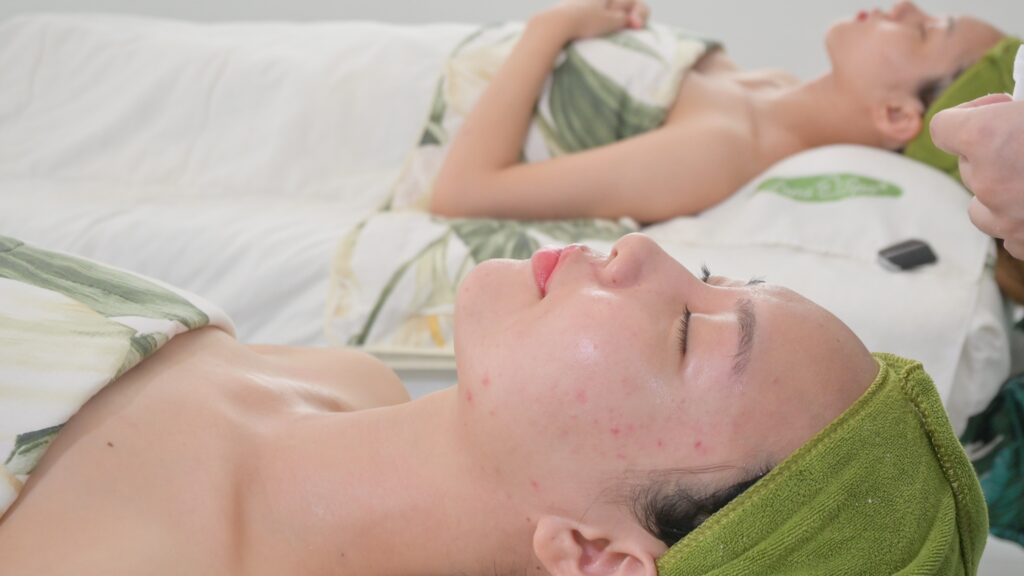
Variant A — PK38 to PK44: Step 1 — Skin cleansing: makeup removal, cleansing, exfoliation · Step 2 — Clearing congestion: steaming, acne softening, sebum extraction · Step 3 — Acne management: comedone extraction, antisepsis, disinfection · Step 4 — Soothing mask to reduce inflammatory swelling · Step 5 — Topical anaesthetic on the treatment area · Step 6 — The mesotherapy injection procedure · Step 7 — Cold electrophoresis to calm the skin · Step 8 — Recovery mask and Celluma LED · Step 8 — Moisturiser + sunscreen · Step 9 — Scalp massage, a short moment to relax.
Variant B — PK45, PK46, PK47: identical, except step 7 is massage plus cold electrophoresis to calm the skin. Two details worth noting: cleansing and congestion clearing come before the injection, because delivering actives through a surface with active comedones is not advisable; and the recovery mask with Celluma LED is part of the standard protocol, not an add-on.
⑦ Who is suitable — and who is not
Suitable: skin that stays dry despite adequate moisturiser; dull, tired skin from poor sleep, stress or long hours in air conditioning; early ageing with loss of bounce and fine lines; thin atrophic skin, telangiectasia, or damage from overused peels, corticosteroids or aggressive treatment; weakened skin recovering after laser; mild to moderate lower-face laxity.
Not suitable, should wait, or should treat something else first:
- Significant laxity with the expectation that meso replaces lifting — the right advice is a mechanical approach, including when Lona does not offer it.
- Severe inflammatory acne, active dermatitis, or infection in the intended area — injecting through inflamed tissue drives the problem deeper.
- Melasma or a pigment disorder as the primary problem — that needs its own protocol; using meso as the main strategy costs time.
- An expectation that “whitening” will change baseline complexion — Lona brightens and evens tone, does not change baseline complexion, and does not administer intravenous whitening.
- Pregnancy or breastfeeding — wait.
- Active autoimmune disease, immunosuppressants, or anticoagulants — specialist evaluation first.
- Keloid tendency, or a history of unusual reactions to injectable procedures.
- Known allergy to a product component — for Linerase specifically, a heterologous biological collagen, allergy history must be disclosed in full.
- No time to complete a course — biostimulation works on the tissue’s regeneration cycle; one session and then stopping is a reliable way to see nothing.
⑧ Frequently asked questions
Are “meso” and “mesotherapy” the same thing?
Yes — “meso” is the short form of mesotherapy, the technique of delivering actives directly into the dermis by micro-injection. What differentiates treatments is which active is injected and how it is delivered, not the name.
How does mesotherapy differ from a skinbooster?
As the catalogue classifies them: a meso cocktail combines several actives in one vial for broad nourishment; a skinbooster focuses on placing micro-linked or non-cross-linked HA into the dermis to restructure the skin as an “endogenous water reservoir”. In practice the two are often combined according to skin condition.
Thread lifting versus meso/BAP — which should I choose?
They differ in kind. Thread lifting is mechanical — threads placed to pull descended tissue upward. Meso and BAP are biological — stimulating that tissue to rebuild collagen and hold water. If established laxity is the main issue, the mechanical approach is correct, and since Lona does not perform thread lifting you will be told that directly.
What is Rejuran, and can a topical “Rejuran” cosmetic replace the injection?
In Lona’s catalogue, Rejuran is the polynucleotide group used by injection — Rejuran Healer in Meso skin booster (PK41) and Rejuran S in the BAP services. Topical products with a similar brand name are skincare, acting on the surface and stratum corneum. They maintain results well but do not substitute for intradermal delivery, because the stratum corneum is a real barrier.
Does Lona have Profhilo?
Yes. Profhilo sits in the non-cross-linked HA group, used for BAP technique in OBP Lux BAP (PK45) and Bio BAP pro (PK46). The same group also includes Save B32 / Save B32 SP, Ejal 40, Jalupro Super Hydro and Karisma; the semi-cross-linked group includes Vivacy Hydromax, Opera, Phaseliss, Skinfill, Teoxane Redensity, Infini and RRS long lasting. Which line is used is the doctor’s decision based on skin condition, not a brand ranking.
Is injectable “skin whitening” real?
Separate it into two claims. Localised brightening and evening of tone is real — through tranexamic acid, the antioxidant component of meso cocktails, and the fact that well-hydrated skin reflects light better. Changing your baseline complexion is not what an injection does, and Lona does not perform intravenous or systemic whitening.
Does it hurt, and is there downtime?
The protocol includes topical anaesthetic before and cold electrophoresis after. Per the catalogue, with non-cross-linked HA injected by sharp needle at BAP points, small papules typically flatten completely within about 12 – 24 hours; with cannula technique, bruising and papule risk is minimised.
How long until I see results?
It depends on the active group. Hydrating actives are felt sooner — the catalogue notes a clear plumped, dewy effect within 24 – 48 hours with non-cross-linked HA. Restructuring actives follow the tissue’s own timeline: for Linerase, results increase over 2 – 4 weeks and persist for many months. Semi-cross-linked HA persists 6 – 9 months, up to 12 months depending on the individual.
What does it cost in USD?
Approximately, at the reference rate above: from ≈ 160 USD for Meso eye basic, Meso rose booster and Meso lip booster; ≈ 240 USD for Meso Alluring; ≈ 320 USD for Meso HA pro active; ≈ 400 USD for Meso skin booster and Bio BAP basic; ≈ 480 USD for Bio BAP pro; ≈ 560 USD for Meso Reju Booster and OBP Lux BAP. Approximate, for reference only, at 1 USD ≈ 25,600 VND. The VND figures are listed prices, excluding periodic offers, and subject to adjustment based on each patient’s specific condition.
Where can I get mesotherapy or skinboosters in Can Tho?
Lona Skin Lab Dermatology Clinic (Phòng khám Chuyên khoa Da liễu Lona Skin Lab) in Can Tho — T2 Dinh Cong Trang Street, Ninh Kieu Ward, Can Tho City, Vietnam. Clinically responsible physician: MSc. Dr. Le Thi Thao Vy, Dermatology. Operating licence 735/CT-GPHĐ. The plan is finalised after skin analysis and examination, not over messages.
If I have meso, do I still need filler?
They solve different problems, so it depends on your problem rather than a sales sequence. If volume is clearly deficient, meso will not fill it; if skin is thin and dry, filler will not make it look good. When both apply, the doctor usually addresses skin quality first or in parallel.
How long before my flight should the procedure be?
Lona recommends at least 2 weeks, with the exact interval given by your treating doctor. For this family, also ask how many sessions the course requires and how far apart they fall, so you know whether your trip is long enough.
⑨ Home care after treatment
This is the family where home care most visibly affects the result, because the goal is skin quality rather than shape. Three things: adequate daily sun protection — skin just stimulated to regenerate and then exposed to sun undoes its own work; moisturising and barrier repair to hold the water that has been restored; and gentle cleansing, avoiding retinoids and exfoliating acids in the first days unless your doctor says otherwise. Corresponding product groups are at lona.vn — the sunscreen group, the barrier-repair moisturiser group, and the post-procedure soothing and recovery serum group.
⑩ Message Lona
If you are not sure whether your skin is dehydrated, thinning, or beginning to sag — and therefore do not know where to start — message us for a treatment plan from a dermatologist and skin-analysis technician:
- Messenger: https://m.me/lonaskinlab.vn?ref=cum-11
- Zalo: https://zalo.me/4428027389339512399
- Hotline: 0777 679 902
From abroad: WhatsApp +84 777 679 902 · Contact@lona.vn.
Lona Skin Lab Dermatology Clinic (Phòng khám Chuyên khoa Da liễu Lona Skin Lab) T2, đường Đinh Công Tráng, phường Ninh Kiều, TP. Cần Thơ. Hotline: 0777 679 902 · 0932 927 723 Operating licence: 735/CT-GPHĐ · Advertising licence: 4770/XNQC-SYT Clinically responsible physician: ThS.BS Lê Thị Thảo Vy — Dermatology
Chú ý: Nội dung bài viết chỉ mang tính chất tham khảo, không thay thế cho việc chẩn đoán hoặc điều trị y khoa. Vui lòng tham khảo ý kiến bác sĩ trước khi áp dụng bất kỳ phương pháp nào. Xem thêm