

Most English-language pages about scar treatment in Vietnam make the same mistake: they collapse everything into one word, “scars”, then list every available machine. In reality, keloid scars and atrophic scars form through opposite mechanisms, post-acne icepick scars and post-pregnancy stretch marks sit in different tissue planes, and a method that works well on one type can make another worse. This page separates the types first, then talks about intervention.

① The biology: why these four conditions are not variations of one thing
Skin heals through three overlapping phases — inflammation, proliferation, remodelling. During proliferation, fibroblasts migrate into the wound and lay down new collagen. During remodelling, which runs for months, immature collagen (mostly Type III) is progressively replaced by mature Type I collagen and realigned along the skin’s tension lines. A scar is what happens when that third phase goes off course, in one of two directions.
Too much — keloid and hypertrophic scars. Fibroblasts do not stand down. They keep synthesising collagen after the wound has closed, building fibrous tissue that sits above the skin surface. A hypertrophic scar stays within the original wound borders and tends to soften over time. A keloid extends beyond the original borders, can itch, hurt or feel tight, and is notoriously prone to recurrence after treatment. This type is strongly constitutional — the same wound leaves a flat line on one person and a raised mass on another.
Too little — atrophic and post-acne scars. Lost tissue is not replaced, and the surface drops into a depression. Post-acne atrophic scars add a mechanical factor: fibrotic tethers form beneath the scar floor and anchor the surface down to deeper tissue. This is why surface-only methods so often produce limited improvement — the anchor is still there. This group subdivides into three morphologies that are not treated the same way:
- Rolling scars — shallow sloping edges, wide floor, visible as an undulating surface under raking light. The main culprit is the fibrotic tether.
- Boxcar scars — sharply vertical walls, flat floor, wide diameter. The problem is both the ragged rim and the lost volume.
- Icepick scars — narrow opening, a tract that runs deep like a puncture. Tiny surface area, significant depth, which is why surface resurfacing barely reaches the floor.
Stretch marks are neither of the above. Striae distensae form when skin is stretched faster than its connective tissue can adapt: puberty, pregnancy, rapid weight gain, rapid muscle gain. Elastin and collagen networks in the dermis rupture perpendicular to the direction of tension, leaving parallel atrophic grooves. Striae have two clinically distinct phases:
- Striae rubrae — the new phase, still inflamed, still vascular, red or purple. Tissue in this phase still responds, because fibrosis is not complete.
- Striae albae — the old phase, fibrotic, depleted of pigment cells, ivory-white, with a thin wrinkled surface. Much harder, and the realistic goal is to make grooves shallower and narrower, not to erase them.
One final point that matters specifically for Vietnamese and broader Asian skin: most of us sit in the skin types prone to post-inflammatory hyperpigmentation (PIH). Any intervention that generates excess inflammation can leave a dark mark more troublesome than the original scar. Every method-selection decision below turns on that sentence.
⑦ Planning the trip: overseas Vietnamese, flights, and what fits into one visit
If you are reading this from the United States, Australia, Canada or Europe, the question that comes first is not “which laser” — it is “how do I fit this into a trip home”. So this section comes second, not last.
The hard constraint is your flight date. If your skin is in the crusting phase or still red when you board a return flight, every follow-up has to happen through a screen. For that reason:
Lona recommends leaving at least 2 weeks between your procedure and your flight. That is the clinic’s general recommendation; the specific interval for your case is set by your treating doctor, because an ablative-laser protocol and a radiofrequency microneedling protocol do not carry the same timeline.
Be realistic about what one trip achieves. Atrophic acne scarring is a multi-session problem, not a one-visit problem. The sensible way to use a trip home is: in-person consultation with skin imaging, the main interventional session, the full recovery phase completed in Vietnam, a long-term home-care plan to maintain from abroad, and the next session block discussed in advance. If someone promises you a complete scar correction in a single visit, be sceptical.
Combine procedures into one block. Patients travelling from a distance should group procedures into a single visit block rather than making separate trips for small items. With this particular group of services, that happens to align with how the protocols are already built — the combination protocols are designed to perform several mechanisms within one session.
Two shorter-distance layers, for context. Patients coming from the Mekong Delta provinces up to Can Tho usually want to know whether it is a same-day trip. Patients coming from Ho Chi Minh City want to know whether it is worth a weekend day. In both cases the answer depends on which protocol tier you are booked for, and more importantly on what your skin looks like when you walk out: protocols that include fractional CO2 laser involve a crusting phase, while radiofrequency microneedling protocols are described as leaving only one to two days of pink flushing. Those are two very different travel-home arrangements.
Consult remotely before you book flights. Send photographs and a description, and we can tell you whether you fall into the “treat now” group or the “wait first” group described in section ⑥ — before you buy a ticket.
- WhatsApp: +84 777 679 902
- Zalo: https://zalo.me/4428027389339512399
- Email: Contact@lona.vn

② The honest map of available approaches — including what Lona does not do
The “offered” and “not in the catalogue” labels below reflect the published service catalogue as of October 2026. If you need a direction that is not listed, ask — if it is not something done here, you will be told so directly and pointed somewhere suitable.
This is the section commercial pages skip, because telling the truth costs you some bookings. But patients who read ten clinics notice which one did not hide anything.
1. Topical silicone — gels and sheets (the most widely recognised brand name in Vietnam is Dermatix). Principle: occlusion, hydration of the stratum corneum, modulation of fibroblast signalling while the scar is still immature. Suits: new scars within the first months, especially as keloid and hypertrophic prophylaxis in predisposed people. Limits: for scars that stabilised years ago — old atrophic scars, white striae — topical occlusion does not change tissue that has already fibrosed. This is a home-care route and is not part of the twelve services in this group; if your scar is still immature, what you need is consistency, not a procedure booking.
2. Keloid and hypertrophic scar interventions: intralesional injection, cryotherapy, surgical excision with adjuvant brachytherapy. Principle: suppress or remove excess fibrous tissue. Suits: the excess direction of scarring. Limits: high recurrence rates, long follow-up, and the surgical-radiotherapy route belongs in a more specialised setting. Lona has no service in this group for keloid scars. All twelve services here address the deficit direction: atrophic scars, acne scars, stretch marks. If your problem is a raised scar mass, the correct next step is an in-person dermatology consultation for classification — not picking an atrophic-scar protocol from the table below.
3. Mechanical release: subcision, blunt-cannula dissection. Principle: cut the fibrotic tethers anchoring the surface downward, releasing the depression. Suits: rolling and deep boxcar scars — the types where the tether is the culprit. Limits: does not address a ragged rim, does not reach the floor of an icepick tract, and without an anti-re-adhesion step the freshly separated tissue planes can reattach. Lona does this, always paired with a step that addresses re-adhesion.
4. Focal chemical reconstruction: TCA CROSS. Principle: high-concentration acid applied precisely into the scar tract, producing focal coagulation that stimulates granulation tissue to fill from the floor upward. Suits: icepick and narrow scars — exactly the types surface laser cannot reach. Limits: highly operator-dependent; misplaced or over-concentrated application can widen the scar opening. Lona does this.
5. Ablative thermal resurfacing: fractional CO2 laser. Principle: vaporise microcolumns of tissue, smooth scar rims, restructure the epidermis. Suits: ragged rims, rough texture, dilated pores. Limits: the highest PIH risk group for Vietnamese skin, and it requires downtime with crusting. Lona does this, but as a component inside a combination protocol rather than as a stand-alone intervention.
6. Non-ablative thermal: radiofrequency microneedling (RF Needle). Principle: insulated needles deliver radiofrequency heat into the dermis at a preset depth — the protocol description cites roughly 1.0–3.5 mm for facial scars and 1.5–4.0 mm for striae — breaking up fibrotic adhesions and stimulating collagen while preserving the epidermis. Suits: pigment-prone skin, people who cannot take extended downtime, and large body areas such as abdomen, thighs, buttocks and upper arms. Limits: does not plane down a ragged rim the way ablative laser does. Lona does this, for both scars and striae.
7. Biological delivery into tissue: mesotherapy, micro-injection, cannula delivery. Principle: deliver regenerative agents (PDRN/polynucleotide, hyaluronic acid, growth factors, peptides, exosomes) directly into the dermis — supplying both raw material and signal locally, and acting as a biological spacer against re-adhesion after subcision. Suits: improving skin quality around scars, buffering recovery after aggressive intervention, and stretch marks on any body area. Limits: on its own it does not cut fibrotic tethers, so for tethered atrophic scars it is a combination step, not the primary one. Lona does this.
8. Collagen biostimulators placed into the scar pocket: PCL, PDLLA. Principle: microparticles deposited into the freshly dissected pocket hold it open and drive fibroblasts to build a new collagen network; as the particles resorb, the volume is replaced by the patient’s own living tissue. Suits: broad rolling scars, volume-deficient hollows with lax skin. Limits: not for actively inflamed scars, and depends on correct injection plane. Lona does this.
9. What Lona does not do: autologous fat grafting, surgical scar revision, classical full-face dermabrasion, and all of the keloid interventions in point 2. The reasoning is straightforward: those routes require a different surgical setting, and keeping the catalogue within what the clinic performs routinely — interventional dermatology — produces more consistent outcomes than offering everything.
③ Why Lona built this catalogue around combination protocols
Re-read section ① and the problem becomes obvious: on one face, a person usually has rolling scars (which need the tether cut), icepick scars (which need filling from the tract floor), and rough texture with ragged rims (which needs planing). No single method does all three. That is why this part of the catalogue is organised around combining mechanisms within one session rather than one machine per visit.
The scar protocol therefore runs mechanical → chemical → photothermal: subcision releases the deep fibrotic bands, TCA CROSS triggers fill-in from the floor of icepick tracts, fractional CO2 laser planes the rims and resurfaces the epidermis. The protocol documentation describes this as multi-layer action and states a design goal of reducing session count by roughly 40–60% compared with laser alone. How much any individual improves depends on scar morphology, depth, age and skin type, so read that figure as the protocol’s design intent, not as a guarantee.
Higher tiers add a further layer: loading biological agents into the scar pocket that has just been released. This addresses the specific weakness of subcision alone — the risk of the separated planes reattaching. The agent plays two roles: a mechanical spacer, and a signal moving fibroblasts from a passive to an active state. At the top tier, exosomes are used to suppress micro-inflammation, with the goal of lowering PIH risk — the single largest hazard of ablative laser on Vietnamese skin.
For stretch marks, the logic changes completely. There is no tether to cut and no tract to treat focally. The problem is a ruptured fibre network across a broad area, on body skin that is thicker than facial skin and more pigment-reactive. So the two chosen routes are RF microneedling — deep heat with the epidermis preserved — and mesotherapy delivery. Both avoid broad-area ablative resurfacing.
④ All twelve services compared
| Service | Brand / product used | Invasiveness | Area · indication | Listed price range |
|---|---|---|---|---|
| PK105 — Multi-method scar treatment, Basic | TCA, fractional CO2 | Interventional procedure | Face · atrophic, icepick, sharp-floor scars | from 5,500,000 |
| PK106 — Multi-method scar treatment, Pro | TCA, fractional CO2, RRS Strimatrix, PDRN, exosome | Interventional procedure | Face · atrophic, icepick, sharp-floor scars | from 7,500,000 |
| PK107 — Multi-method scar treatment, Exo+ | TCA, fractional CO2, RRS Strimatrix, PDRN, exosome, biostimulators | Interventional procedure | Face · atrophic, icepick, sharp-floor scars | from 20,000,000 |
| PK108 — Multi-method scar treatment, per-lesion | TCA, fractional CO2, RRS Strimatrix, PDRN, exosome, biostimulators | Interventional procedure | Face · atrophic scars, nodular scars | Not listed — quoted after consultation |
| PK109 — RF Needle Scar Laser Peel | RF Needle + TCA/retinol | Interventional procedure | Face · enlarged pores, post-acne scars | from 5,000,000 |
| PK110 — Scar mesotherapy, Basic | RRS Strimatrix | Micro-injection | Atrophic scars | from 4,000,000 |
| PK111 — Scar mesotherapy, Pro | Rejuran S | Micro-injection | Atrophic scars | from 12,000,000 |
| PK112 — Scar mesotherapy, Exo+ | Gouri, Asthefill, Sculptra | Cannula delivery | Atrophic scars | from 14,000,000 |
| PK113 — RF Needle for stretch marks | RF Needle | Interventional procedure | Striae — both rubrae and albae | from 3,000,000 |
| PK114 — Stretch mark mesotherapy, Basic | RRS Strimatrix | Micro-injection | Striae — both rubrae and albae | from 4,000,000 |
| PK115 — Stretch mark mesotherapy, Exo+ | Opera (semi-crosslinked HA) | Cannula delivery | Striae — both rubrae and albae | from 14,000,000 |
| PK116 — Botox Skin Booster | Botulinum toxin A with mesotherapy agents | Micro-injection | Not yet classified in the service record | Not listed — quoted after consultation |
These are listed prices; they do not include periodic offers and are adjusted according to each patient’s individual condition. PK108 and PK116 have no listed price because the scope depends on lesion count and treatment area — these require a consultation before a quote. Currency reference. Converted at 1 USD ≈ 25,600 VND, the rate used on this page for orientation only — exchange rates move, and the clinic quotes in Vietnamese dong. Approximate, for reference only: 3,000,000 VND ≈ 120 USD · 4,000,000 ≈ 160 USD · 5,000,000 ≈ 200 USD · 5,500,000 ≈ 220 USD · 7,500,000 ≈ 300 USD · 12,000,000 ≈ 480 USD · 14,000,000 ≈ 560 USD · 20,000,000 ≈ 800 USD. These are not firm quotes.
Three things to read alongside the table. First, the Basic → Pro → Exo+ step is not a step up in equipment; it is a step up in how many mechanisms are layered into one session and which class of biological agent is delivered. Second, the scar services (PK105–PK112) and the stretch mark services (PK113–PK115) are not interchangeable, because the underlying mechanisms differ as section ① set out. Third, services listed for “Face” are not used for body striae, and vice versa.
⑤ What actually happens during a session
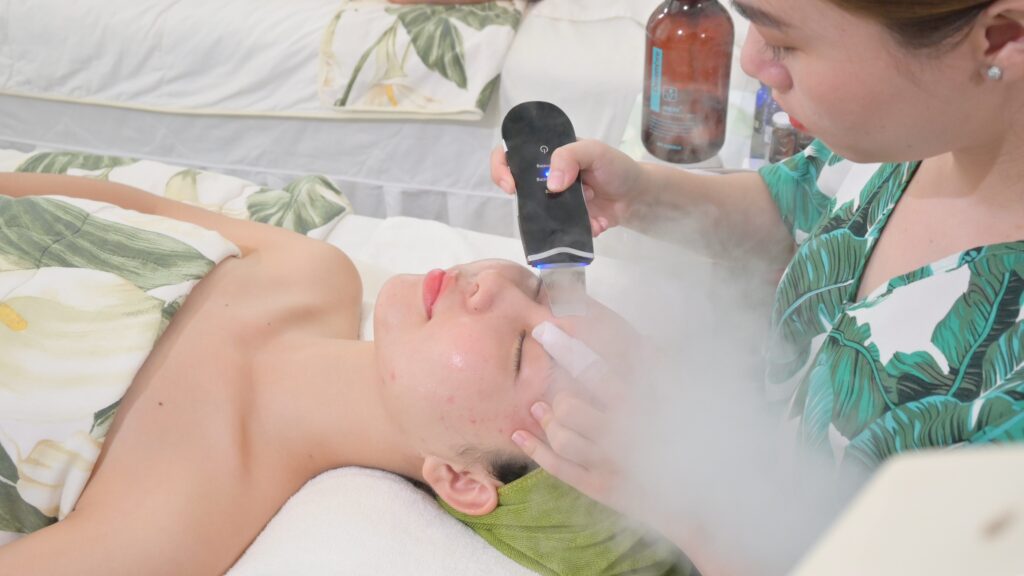
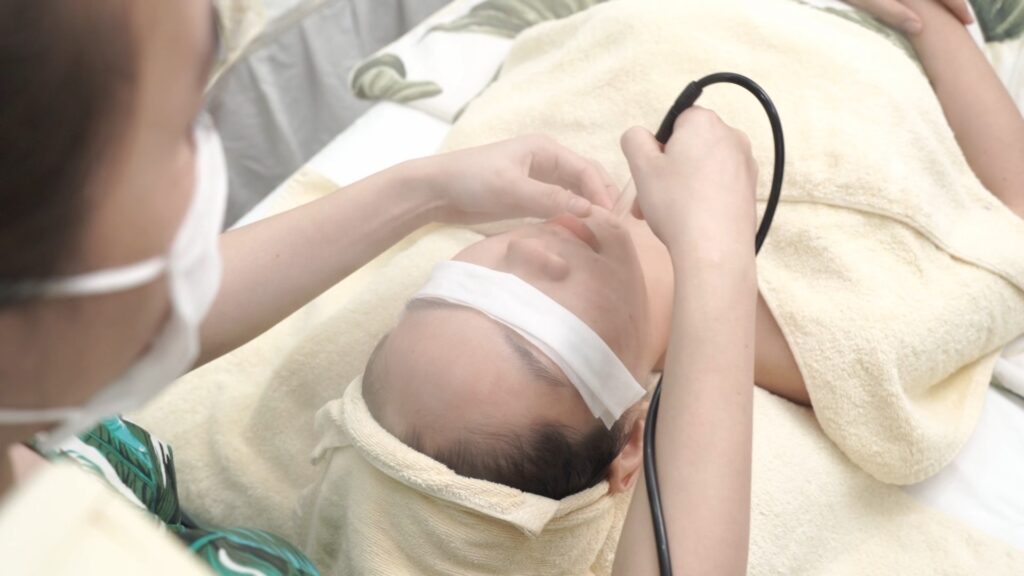
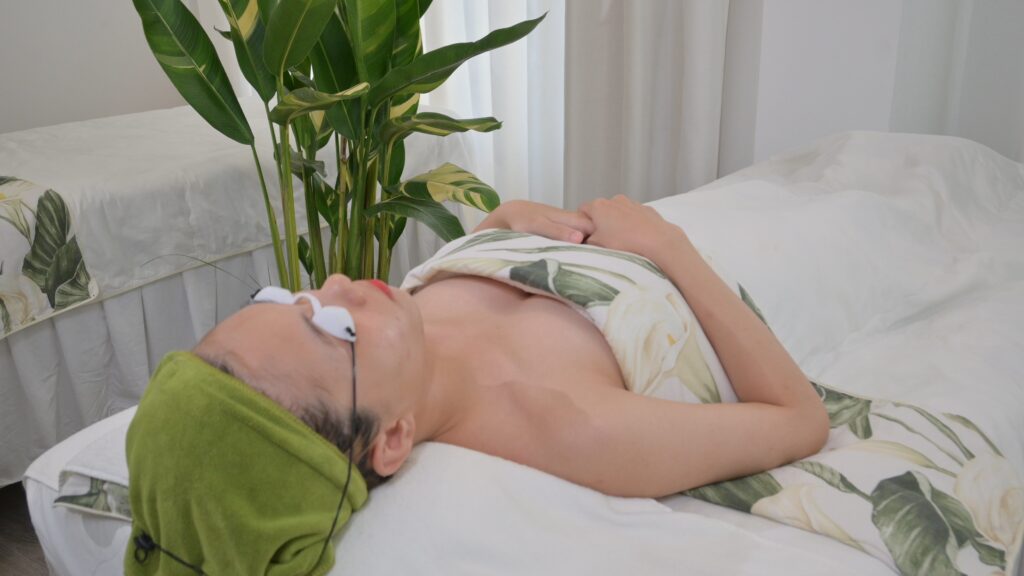
All services in this group share one session framework and differ only in the core procedural step. Below is the full framework for PK106 — Multi-method scar treatment, Pro, with each step kept as written in the clinic’s procedure record:
- Cleansing: makeup removal, face wash, exfoliation
- Decongestion: steaming, acne-softening mask, oil extraction
- Acne handling: comedone extraction, antisepsis, disinfection
- Soothing mask to reduce swelling and inflammation
- Topical anaesthetic applied to the treatment area
- Subcision procedure and TCA application
- Fractional CO2 laser
- Injection of proliferation-stimulating agents into the scar points
- Recovery mask and Celluma light therapy
- Moisturiser + sunscreen
- Scalp massage — a little relaxation to finish
Core procedural step for each of the remaining services, exactly as recorded:
| Service | Core procedural step |
|---|---|
| PK105 | Subcision and TCA application → fractional CO2 laser |
| PK107 | Subcision and TCA application → fractional CO2 laser → full-face exosome or biostimulator injection |
| PK108 | Multi-method scar treatment procedure |
| PK109 | RF Needle procedure → (after the recovery step) TCA/retinol applied and left on the skin |
| PK110, PK114 | Mesotherapy injection → massage and cold iontophoresis to soothe |
| PK111, PK112, PK115 | BAP injection via cannula → massage and cold iontophoresis to soothe |
| PK113 | RF Needle procedure |
Two details in this framework are worth noticing, because they reveal how the clinic frames the problem. Topical anaesthesia always precedes any interventional step. And the recovery mask with Celluma light therapy always follows immediately after the procedure, before moisturiser and sunscreen — meaning the anti-inflammatory phase is built into the treatment session as a mandatory step, not offered as an add-on. PK116 — Botox Skin Booster has no procedure record on file, so this page does not describe a procedure for it.
⑥ Who this suits — and who should not be treated right now
Suitable for the atrophic scar group (PK105–PK112): post-acne scarring that has stabilised, with inflammatory acne already under control; rolling, boxcar or icepick scars on the face; and people who have had multiple laser-only sessions elsewhere yet find the depressions return — that group often still has unreleased fibrotic tethers.
Suitable for the stretch mark group (PK113–PK115): striae on the abdomen, thighs, buttocks or upper arms after pregnancy, rapid weight gain or puberty; both red and white striae, with expectations set correctly — shallower, narrower grooves.
Should wait:
- Active inflammatory acne. Intervening on inflamed skin both aggravates the inflammation and generates new scars. The correct order is treat the acne first.
- Very recent scars. A scar still in remodelling may improve on its own; intervening early means intervening on a picture that has not settled.
- Currently on, or recently off, oral isotretinoin. A doctor must confirm a safe interval before any ablative procedure.
- Pregnant or breastfeeding — a very common situation in the post-pregnancy stretch mark group. Timing must be decided by a doctor.
- Recent heavy sun exposure, skin currently tanned or hyperpigmented. Ablative laser on pigment-reactive skin is the fastest way to trade a depression for a dark mark.
Should go elsewhere, not to this group of services:
- Keloid or hypertrophic scars — raised scar tissue. As section ② states plainly: none of the twelve services here is for that type. You need an in-person dermatology consultation for classification and a different treatment route.
- A known keloid tendency — you have formed keloids at injection sites, ear piercings or surgical incisions. Tell the doctor before any skin-wounding procedure is considered.
- Striae with endocrine warning signs — numerous, wide, deeply purple striae appearing rapidly without pregnancy or weight change, alongside other bodily changes. The first step is an endocrine workup, not a procedure booking.
- A lesion of unclear nature — a depression or firm nodule you are not certain is a scar. It needs to be examined and imaged first.
⑧ Frequently asked questions
Are “pitted scars” and “atrophic scars” the same thing?
“Pitted scars” is the everyday term for post-acne atrophic scarring on the face, in its three morphologies — rolling, boxcar and icepick. “Atrophic scar” is broader and includes depressions from chickenpox or other injury. Both belong to the deficit direction of scarring, so treatment principles are closely related.
Can topical scar products work, or is a procedure always required?
It depends on scar age. For immature scars, topical silicone gels and sheets have a genuine role, particularly as keloid prophylaxis in predisposed people. For stabilised atrophic scars or white striae of several years, topicals cannot change already-fibrosed architecture — that is when dermal intervention becomes relevant.
Can silicone scar gel help pitted acne scars?
Silicone gels and sheets are strongest at modulating a scar while it is still forming, especially keloid and hypertrophic scars. For old atrophic scars — a problem of lost volume and deep fibrotic tethering — a topical mechanism does not reach the tissue plane that needs treating.
Does Lona treat keloid scars?
No. All twelve services in this group address atrophic scars, acne scars and stretch marks. Keloids are the mechanistic opposite and require a different route. If you have a keloid, see a dermatologist for correct classification before deciding anything.
Can stretch marks be removed completely?
No one should promise you that. The realistic goal of currently available methods is shallower grooves, reduced width, less redness in red striae, and better colour match for white striae. Red striae — the newer phase — generally respond better than white.
What is actually injected in “scar injections”?
It depends on the service. Within this group, mesotherapy delivers regenerative agents into the dermis around the scar; biostimulator services place PCL/PDLLA microparticles into the pocket just dissected, to prevent re-adhesion and drive collagen formation; and in the combination protocols, agents are delivered into the scar points immediately after subcision.
Will scar treatment leave me with dark marks?
That risk is real for Vietnamese and Asian skin and is called post-inflammatory hyperpigmentation. Ablative laser carries the highest risk; RF microneedling less, because the epidermis is preserved; mesotherapy causes no surface thermal injury. Lowering this risk is one reason the protocols include anti-inflammatory agent layers and a light-therapy recovery step.
How long is a session and how many will I need?
Session count cannot be stated before an examination, and anywhere giving you a fixed number over chat is guessing. Session length depends on the protocol tier, because the framework includes cleansing, anaesthesia and the light-therapy recovery phase — not just the procedural step.
Should I have a peel or laser first, before scar treatment?
Sequencing should be decided after skin imaging. If your skin is currently weak, thin, red or recovering from over-aggressive treatment elsewhere, the sensible first step is usually to rebuild the skin barrier — which belongs to the skin recovery and resurfacing group of services, not the scar group.
Where can I get acne scar and stretch mark treatment in Can Tho, Vietnam?
At Phòng khám Chuyên khoa Da liễu Lona Skin Lab (Lona Skin Lab Dermatology Specialty Clinic) in Ninh Kieu Ward, Can Tho City. The clinic runs the twelve atrophic scar and stretch mark services listed in section ④, with the doctor performing the examination, scar classification and the procedure. Patients from the Mekong Delta provinces, Ho Chi Minh City and overseas Vietnamese should consult remotely first to schedule correctly.
Roughly what does acne scar treatment cost in Can Tho?
Per section ④, the multi-method scar protocols start from 5,500,000 VND, scar mesotherapy from 4,000,000 VND, and stretch mark services from 3,000,000 VND. These are listed prices; they do not include periodic offers and are adjusted according to each patient’s individual condition. Two services have no listed price and require a consultation before a quote. Currency conversions elsewhere on this page are approximate, for reference only.
⑩ Home care after treatment — half the result happens here
A clinic protocol creates controlled injury; how that tissue heals afterwards largely plays out at home. Three non-negotiables, in order of importance:
Sun protection. This is a precondition, not a polite suggestion. Sun exposure on freshly treated skin sharply raises PIH risk — and a dark mark is harder to resolve than a depression. See the sunscreen range on lona.vn.
Barrier repair. The post-procedure phase needs hydration and lipid-barrier restoration, not active ingredients. See the recovery and moisturiser range on lona.vn.
Gentle cleansing. During crusting or while skin is still flushed, high-foaming cleansers and physical scrubs are the wrong choice. See the gentle cleanser range on lona.vn.
Strong actives — retinoids, exfoliating acids, high-strength vitamin C — return only when your doctor says so, and always later than the moment your skin starts to look fine.
⑨ Message us for a protocol consultation
Atrophic scars and stretch marks both require skin imaging and classification before any method can be chosen — there is no single protocol for every face. Send a few photographs of the area and a short description, and our dermatologist and skin imaging specialist will tell you whether you are in the “treat now” group or the “wait first” group, and how your trip should be arranged.
- Messenger: https://m.me/lonaskinlab.vn?ref=cum-03
- Zalo: https://zalo.me/4428027389339512399
- Hotline: 0777 679 902
- WhatsApp (international): +84 777 679 902 · Email: Contact@lona.vn
“ Phòng khám Chuyên khoa Da liễu Lona Skin Lab T2, đường Đinh Công Tráng, phường Ninh Kiều, TP. Cần Thơ. Hotline: 0777 679 902 · 0932 927 723 Giấy phép hoạt động: 735/CT-GPHĐ Giấy phép quảng cáo: 4770/XNQC-SYT Chịu trách nhiệm chuyên môn: ThS.BS Lê Thị Thảo Vy — chuyên khoa Da liễu “
Chú ý: Nội dung bài viết chỉ mang tính chất tham khảo, không thay thế cho việc chẩn đoán hoặc điều trị y khoa. Vui lòng tham khảo ý kiến bác sĩ trước khi áp dụng bất kỳ phương pháp nào. Xem thêm