

Two very different groups of patients come to this set of services, and they need opposite things. The first group wants resurfacing: rough texture, enlarged pores, dullness, uneven surface. The second group is the opposite — their skin has already been resurfaced too many times and is now thin, red, stinging and flaking, and what they need is to stop ablating and repair the barrier. Confusing those two groups is the single most common cause of the damaged skin we see. This page separates them first, then talks about methods.
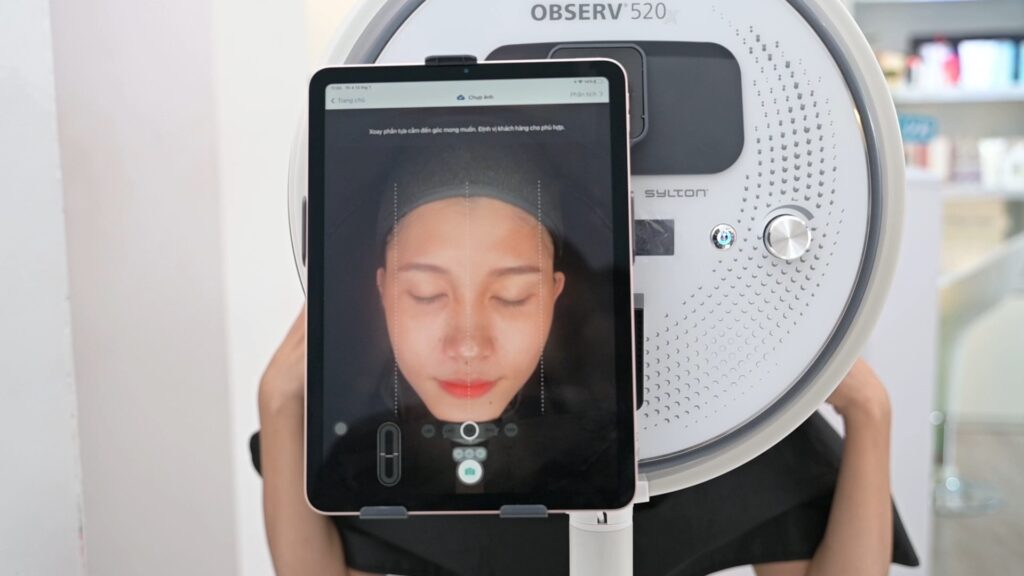
① How the skin barrier works, and why “weak skin” is really five different conditions
The outermost layer of skin — the stratum corneum — is not inert dead tissue. It is a brick-and-mortar structure: corneocytes are the bricks, and the mortar is the intercellular lipid matrix of ceramides, cholesterol and free fatty acids held in a fairly narrow ratio. This structure does two jobs at once: it holds water in (limiting transepidermal water loss, TEWL) and keeps irritants and microbes out. Below it, the basement membrane anchors the epidermis to the dermis; deeper still, the dermis holds the collagen–elastin network and the fibroblasts.
When the mortar is depleted, two failures happen together: water escapes faster, so skin feels tight and flakes; and external substances penetrate further, so skin stings, reddens and reacts to products it previously tolerated. This is why a person can be oily and flaking at the same time — sebaceous glands increase output to compensate for water loss above.
The problem is that “weak skin” in everyday language collapses at least five mechanistically different conditions:
- Constitutionally sensitive skin. A low tolerance threshold from the start, often with a history of atopic dermatitis. The barrier is structurally thin, not damaged.
- A barrier damaged by over-treatment. Repeated peels, aggressive microneedling, laser sessions spaced too closely, strong actives layered on top of each other. The skin was previously healthy; the problem is damage accumulating faster than renewal. This group recovers, provided the cause stops.
- Topical-steroid-damaged skin. Prolonged topical corticosteroid use — in Vietnam usually via mixed creams or self-prescribed ointments — atrophies the epidermis and dermis, suppresses fibroblasts, dilates superficial vessels, and creates dependence: stopping triggers severe rebound flushing. This is the most serious condition in the group and needs a doctor guiding the process, not another treatment course.
- Telangiectasia and persistent facial redness. Permanently dilated superficial vessels, flushing with heat, alcohol, spice or emotion. This may be a skin disease requiring its own treatment, not simply “weak skin”.
- Dehydrated skin. Different from dry skin lacking oil. Dehydration is a deficit of water in the upper layers and can occur on an oily face.
On the other side, “resurfacing” is not one thing either. Epidermal turnover runs continuously; resurfacing means intervening to accelerate or reorganise it. The depth of intervention varies enormously: removing some aged stratum corneum at a very superficial level and creating micro-injury down into the dermis to drive collagen synthesis are separated by a wide margin of risk.
On enlarged pores specifically — the most searched topic in this group — three distinct causes need three different approaches:
1. Sebum and congestion. The follicular opening is distended by sebum and keratin inside it. The correct direction is deep cleansing and reducing oil output. 2. Loss of elasticity around the follicular opening. Tissue around the pore slackens with age or photodamage, so pores look wide and stretch into a teardrop shape. The correct direction is dermal collagen stimulation. 3. Peri-follicular scarring. These are in fact very small post-acne atrophic scars, not dilated pores. The correct direction belongs to scar treatment, not cleansing or hydration.
One person usually has all three in different proportions. That is why “what shrinks pores” has no universal answer — the proportions have to be seen on imaging first.
⑦ Planning the trip: this is the easiest service group to schedule from abroad
Good news for patients travelling in, and the reason this group is often scheduled into a first trip home.
Most of these services involve little or no downtime. Per the service descriptions: Celluma light therapy is entirely gentle, painless and generates no heat; the recovery peel does not cause thick sheet peeling and requires no downtime; carbon laser is not painful, needs no topical anaesthetic, and normal activity and makeup are possible immediately afterwards. For these, a same-day round trip from the Mekong Delta provinces is realistic. Two exceptions to ask about in advance: micro-injection services can leave temporary papules, and the combined RF microneedling plus fractional CO2 protocol involves a crusting phase. Those two need different scheduling.
From Ho Chi Minh City, or from abroad: combine procedures into one block. Discuss in advance what your session can include, because several services in this group can be sequenced within a single visit if the skin tolerates it. For patients flying in from the United States, Australia, Canada or Europe, barrier recovery is well suited to a single trip home: the interventions are light, repeatable, and most of the maintenance work lives in home care — which travels back with you.
This group is also the right one to do first. If you plan scar work or laser on a later trip, rebuilding the barrier now makes that later trip safer. Intervening aggressively on a compromised barrier is how people end up needing this service group in the first place.
The flight rule still applies:
Lona recommends leaving at least 2 weeks between your procedure and your flight. That is the clinic’s general recommendation; the specific interval is set by your treating doctor — a light therapy session and a combined RF-plus-laser session do not share the same timeline.
Patients travelling from a distance should group procedures into one block and consult remotely before flying:
- WhatsApp: +84 777 679 902
- Zalo: https://zalo.me/4428027389339512399
- Email: Contact@lona.vn
Send photographs and a list of what you are currently using before you book — particularly if you fall into the compromised-barrier group, which is the group most likely to be told on arrival that treatment should be postponed.
② The honest map of recovery and resurfacing approaches — including what Lona does not do
The “offered” and “not in the catalogue” labels below reflect the published service catalogue as of October 2026. If you need a direction that is not listed, ask — if it is not something done here, you will be told so directly and pointed somewhere suitable.
1. Deep ablative chemical peels (high-concentration full-face TCA, phenol, deep peel formulations). Principle: controlled chemical injury to deeper layers, forcing full regeneration. Suits: a narrow set of pigment and texture indications on skin that tolerates it. Limits: very high PIH risk on Vietnamese skin, extended downtime, and no place at all on an already compromised barrier. Broad-area deep peeling is not in this catalogue. A clarification worth making: at Lona, TCA is used as focal application into the scar tract (TCA CROSS) within the scar treatment services — a completely different technique from full-face TCA peeling, despite sharing an ingredient name.
2. New-generation chemical peels aimed at deep cleansing and repair. Principle: second- and third-generation acids at gentle concentrations (PHAs such as gluconolactone and lactobionic acid, LHA, mandelic acid) combined with soothing and lipid-restoring complexes (panthenol/B5, ceramides, hyaluronic acid, niacinamide, Centella asiatica). The goal is not thick sheet peeling but barrier-preserving biological turnover. Suits: thin and weak skin, sensitive skin, skin recovering from over-treatment, skin that needs follicular cleansing but cannot tolerate strong peels. Limits: not a tool for deep scarring or deep melasma. Lona does this.
3. Non-thermal biological light (LED / Celluma). Principle: different wavelengths act differently — blue 465 nm on acne bacteria, red 640 nm on cellular ATP and collagen synthesis, near-infrared 880 nm penetrating deepest, reducing swelling and bruising with anti-inflammatory effect. The description cites near-infrared being used to shorten healing time after procedures. Suits: inflamed or red skin, skin immediately post-procedure, and anyone needing an intervention that is non-invasive, non-thermal and downtime-free. Limits: it does not ablate, so it does not replace structural resurfacing. Lona does this.
4. Transdermal delivery through micro-channels: microneedling / nano-needling (MTS). Principle: create millions of temporary micro-channels in the epidermis so actives penetrate deeply and diffuse evenly. Suits: people needing whole-surface improvement — rough texture, wide pores, shallow scarring over a broad area — with very short downtime, and people who do not want the papules that micro-injection leaves. Limits: limited depth, so it does not address deep scars or fibrotic tethering. Lona does this.
5. Dermal micro-injection (mesotherapy). Principle: deliver different agent classes into the dermis depending on the goal — non-crosslinked hyaluronic acid for dehydrated skin, exosomes for damaged and chronically inflamed skin, micro-dosed botulinum toxin for oily skin and dilated pores. Suits: one agent class per goal, which is why this must be prescribed by a doctor after imaging. Limits: it is an invasive procedure, can leave temporary papules, and is unsuitable when there is local infection. Lona does this.
6. Laser toning with activated carbon (carbon laser, Nd:YAG 1064 nm). Principle: a nano-carbon mask absorbs sebum inside the follicular openings; the laser is selectively absorbed by the carbon particles and micro-explodes, carrying away the carbon along with aged keratin. Suits: oily, congested, dull skin with pores enlarged by cause one in section ①. Described as painless, requiring no topical anaesthetic and no downtime. Limits: it acts on the surface and the sebaceous glands, so it does little for pores enlarged by elasticity loss or scarring. Lona does this.
7. Non-ablative thermal: RF microneedling. Principle: insulated needles deliver heat into the dermis at preset depth — the protocol description cites roughly 1.5–3.5 mm — stimulating tissue remodelling while preserving the epidermis. Suits: pores enlarged by cause two, skin laxity, thin atrophic skin that needs thickening. Limits: does not plane down a ragged surface. Lona does this.
8. Ablative thermal: fractional CO2 laser. Principle: vaporise microcolumns of tissue to resurface. Suits: heavily roughened texture, ragged scar rims. Limits: the highest PIH risk, and a crusting downtime phase. Lona does this, but within this group it is paired with RF microneedling as a multi-layer protocol, never stand-alone.
9. What Lona does not do. Intravenous whitening or IV nutrient infusions; autologous stem cell injection or infusion; full-face mechanical dermabrasion; and the deep broad-area peeling in point 1. The reasoning: the first three sit outside the interventional dermatology scope the clinic performs routinely, and the fourth carries a risk profile on Vietnamese skin that is not proportionate to its benefit when lower-risk routes reach similar goals.
③ What Lona chose, and why
The organising principle of this whole group is one sentence: intervene enough to reach the goal, and no further. That sounds like a slogan, but it has a concrete consequence — it is why the catalogue contains four non-invasive or minimally invasive services (biological light therapy, nano-needling, recovery peel, carbon laser) positioned ahead of the injection and thermal services.
For compromised skin, the stated purpose in the service record is to restore the skin base, repair the protective barrier and reduce irritation — not to resurface. Three services serve this purpose: Celluma biological light therapy for sensitive, irritated, weak, thin and red skin; the recovery peel for steroid-damaged and thin, red skin; and nano-needling with actives for thin, weak skin. That order is deliberate: the gentlest comes first.
For the recovery mesotherapy group, the service record names Exocode as the preferred exosome line for the Meso Exosome service. The reasoning sits in the indication itself: atrophic skin, steroid damage, telangiectatic redness, or skin weakened after excessive treatment and peeling. This group cannot absorb further injury — so the right tool is one that delivers repair signalling and anti-inflammatory action, not one that ablates more. Per the description, extracellular vesicles in the 30–150 nm range fuse readily with cell membranes and contain no cell nucleus, giving high biocompatibility. The protocol is run by the doctor performing the examination, imaging, exosome line selection and micro-injection; patients inspect the security seal and break the seal on the product themselves before treatment — a small detail that exists because biological agents are the most commonly counterfeited category on this market.
For the resurfacing group, the stated purposes map onto the three pore causes in section ①: carbon laser for the sebum and congestion branch; micro-botox combined with HA for the oil and follicular-opening branch; RF microneedling combined with fractional CO2 for the elasticity-loss and ageing-texture branch. And meso HA for dehydrated skin — where the problem is not structure but water content in the tissue.
④ All nine services compared
| Service | Brand / product used | Invasiveness | Area · indication | Listed price range |
|---|---|---|---|---|
| PK61 — Celluma Reju | Celluma LED with exosome | No | Face · sensitive, irritated, weak, thin, red skin | from 995,000 |
| PK64 — MTS skin recovery | Nano-needling with stem cell concentrate / proliferative actives | No | Face · irritated, sensitive, weak, thin, red skin | from 1,950,000 |
| PK65 — Recovery Peel | Synergy, Celestetic | No | Face · steroid-damaged skin, thin and red skin | from 1,950,000 |
| PK92 — Carbon laser | Nd:YAG laser | — | Face · oily skin, acne | from 1,500,000 |
| PK89 — Meso HA | HA 35 RRS | — | Face · dehydrated skin | from 4,000,000 |
| PK91 — RF Needle + Fractional multi-layer rejuvenation | RF Needle + fractional CO2 laser | — | Face · loss of firmness, uneven tone | from 4,000,000 |
| PK62 — Meso exosome | Exosome: ASCE, Exocode, Exowhite, AnteAge — Exocode preferred | Yes | Face · irritated, sensitive, steroid-damaged, weak, thin, red skin | from 8,000,000 |
| PK90 — Micro botox | HA 35 RRS with botulinum toxin: Korean (Beautem), German (Xeomin), US (Allergan) | — | Face · oily skin, enlarged pores | from 8,000,000 |
| PK63 — Meso biosome | AnteAge | Yes | Face · irritated, sensitive, steroid-damaged, weak, thin, red skin | Not listed — quoted after consultation |
These are listed prices; they do not include periodic offers and are adjusted according to each patient’s individual condition. PK63 — Meso biosome has no listed price because it depends on indication and dosage — it requires a consultation before a quote. Currency reference. Converted at 1 USD ≈ 25,600 VND, the rate used on this page for orientation only — exchange rates move, and the clinic quotes in Vietnamese dong. Approximate, for reference only: 995,000 VND ≈ 38 USD · 1,500,000 ≈ 60 USD · 4,000,000 ≈ 160 USD · 8,000,000 ≈ 320 USD. These are not firm quotes.
Read this table along the axis of increasing intervention depth, not price. The first three services are all recorded as non-invasive and all target compromised skin. The two recovery mesotherapy services are recorded as invasive. The four in the middle — carbon laser, meso HA, combined RF microneedling, micro botox — are the resurfacing and regulating group, for skin healthy enough to receive intervention.
One point worth stating plainly: a higher price does not mean a better fit. Steroid-damaged skin in a rebound flare usually needs a service from the top of this table, not the bottom.
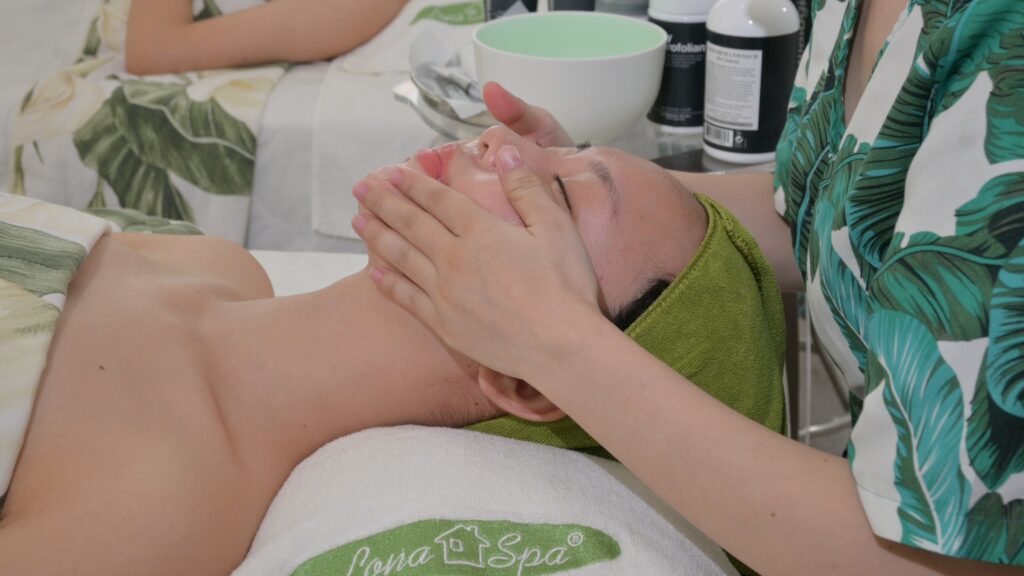
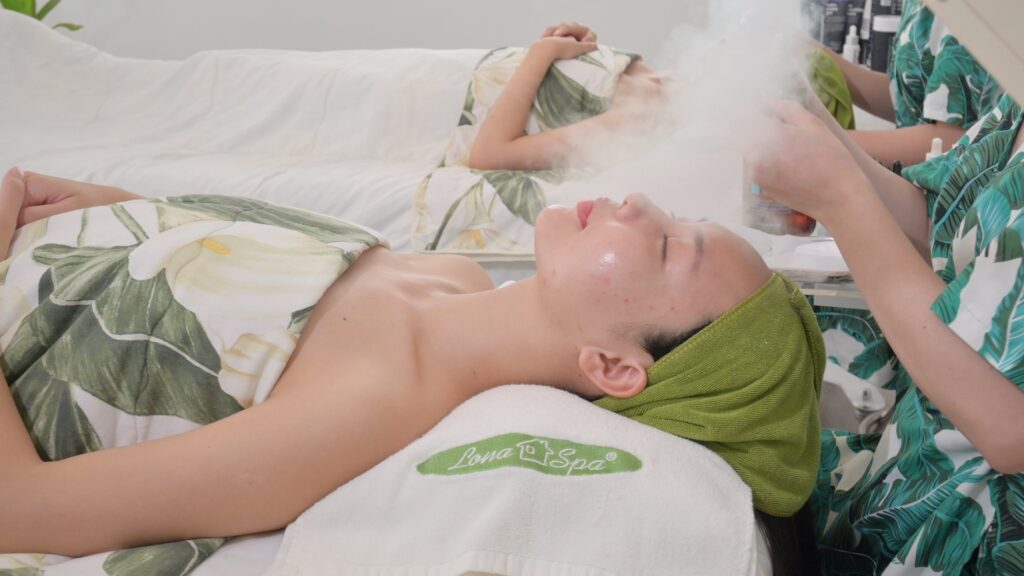
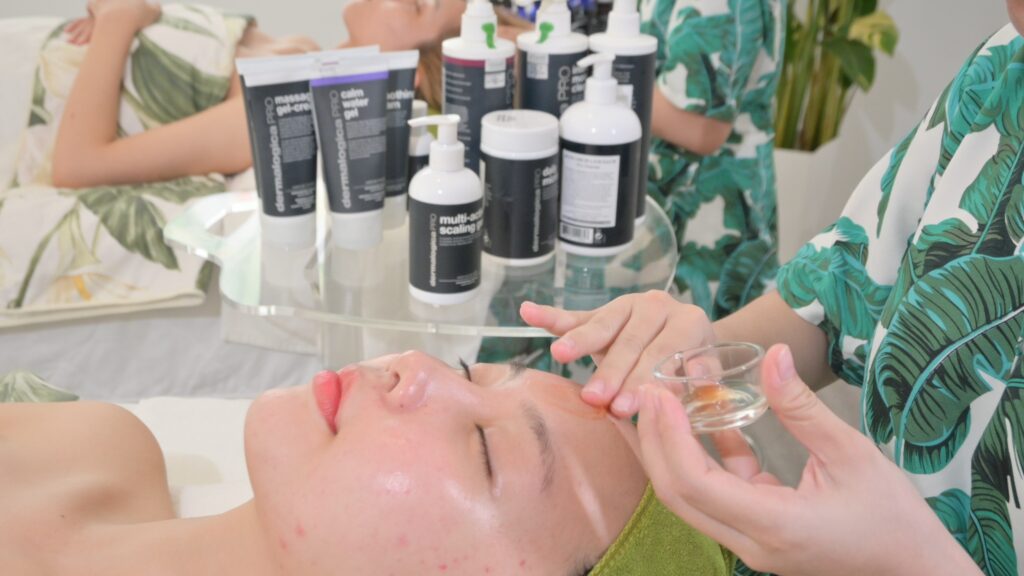
⑤ What actually happens during a session
This group runs two different session frameworks, and the difference between them reveals the logic of each.
The Recovery Peel framework (PK65) — the repair group, exactly as recorded in the clinic’s procedure sheet:
- Cleansing: makeup removal, face wash
- Decongestion: steaming, acne-softening mask, oil extraction
- Comedone cleansing — for acne peels
- Peel performed as prescribed
- Recovery mask and Celluma light therapy
- Skin soothing, application of recovery products
- Post-treatment sunscreen
- Scalp massage — a little relaxation to finish
Note two details. The cleansing step here has no exfoliation — on thin, weak skin, adding a keratolytic step before a peel is not sensible. And soothing with recovery products is a separate step of its own, placed before sunscreen.
The injection and procedure framework (PK62, PK63, PK89, PK90) — exactly as recorded:
- Cleansing: makeup removal, face wash, exfoliation
- Decongestion: steaming, acne-softening mask, oil extraction
- Acne handling: comedone extraction, antisepsis, disinfection
- Soothing mask to reduce swelling and inflammation
- Topical anaesthetic applied to the treatment area
- Mesotherapy injection procedure
- Massage and cold iontophoresis to soothe the skin
- Recovery mask and Celluma light therapy
- Moisturiser + sunscreen
- Scalp massage — a little relaxation to finish
Core procedural step for the remaining services, exactly as recorded:
| Service | Core procedural step |
|---|---|
| PK61 | Celluma light therapy procedure (this framework has no anaesthetic step) |
| PK64 | Nano-needling procedure |
| PK91 | RF Needle procedure → skin soothing with recovery serum → fractional CO2 laser procedure |
| PK92 | Laser toning with the Nd:YAG 1064 nm laser → panthenol applied to soothe the skin |
The most notable shared feature: the recovery mask with Celluma light therapy appears in all nine services, always after the procedural step and before moisturiser and sunscreen. The anti-inflammatory phase is treated as part of the session, not as an upsell. And sunscreen is the final step of every framework, without exception.
⑥ Who this suits — and who should not be treated right now
Suitable for the repair group (PK61, PK64, PK65, PK62, PK63): skin currently irritated, stinging, red and burning; visibly thin skin with visible vessels; steroid-damaged skin confirmed by a doctor and under management; skin flaking after a course of over-aggressive treatment or peeling; and skin that needs rapid anti-inflammatory support after other invasive procedures.
Suitable for the resurfacing and regulating group (PK92, PK89, PK90, PK91): oily, congested, dull skin with pores enlarged by sebum — carbon laser; dehydrated skin with rough surface despite adequate oil — meso HA; oily skin with dilated T-zone pores — micro botox; skin lacking firmness with rough texture and uneven tone — combined RF microneedling.
Should wait, or address something else first:
- Active local infection or fungal infection, or an active perioral herpes outbreak. Any micro-injury procedure should be postponed.
- An active rebound flare after stopping topical steroids. The first step is not choosing a treatment but having a doctor guide the withdrawal phase. Getting the timing wrong can worsen the flare.
- Persistent facial redness that has not been examined. Prolonged redness may be a skin disease requiring its own treatment. Imaging and examination come before barrier repair planning.
- Pregnancy or breastfeeding — particularly for services containing botulinum toxin. A doctor must decide.
- Skin currently in the crusting phase from another procedure. Stacking interventions is the fastest way to create exactly the condition this group of services exists to repair.
Should go elsewhere, not to this group:
- “Enlarged pores” that are actually peri-follicular scars. This is cause three in section ①. Cleansing and hydration cannot fill a depression with a floor. The correct route belongs to scar treatment.
- Deep atrophic scars, boxcar scars, icepick scars. Services here improve surface texture but do not cut the deep fibrotic tethers.
- Deep melasma and pigmentation needing a dedicated protocol. Resurfacing can brighten and even out tone, but melasma sits on the pigment axis and has its own protocol.
- Expecting pores to be “removed permanently”. Pores are a normal anatomical structure, not a flaw to erase. The realistic goal is tighter follicular openings and smoother surface texture.
⑧ Frequently asked questions
What is a chemical peel, and does peeling thin the skin?
A peel uses actives to accelerate shedding of aged stratum corneum and skin turnover. A peel at the right indication, concentration and interval does not thin skin. What thins skin is peeling too strongly, too frequently, or peeling already compromised skin. The recovery peel in this group runs the opposite direction: new-generation acids at gentle concentrations with a lipid-restoring complex, aiming to make the skin base thicker.
How should I care for my skin after a peel?
Three things, in order: absolute sun protection; moisturising and lipid-barrier repair; and pausing all strong actives — retinoids, exfoliating acids, high-strength vitamin C — until your doctor clears them. What not to do is use physical scrubs or high-foaming cleansers during this phase.
Is facial flaking after a peel normal?
Light, even flaking over a few days is an expected response to some peels. What is not normal is thick sheet peeling with burning pain, spreading redness, swelling or weeping — those indicate excessive injury and warrant contacting the clinic immediately. If your skin flakes persistently without any peel, the underlying issue may be a damaged barrier, and the answer is repair, not more peeling.
Can sensitive skin have these treatments?
Yes, but only at the right depth of intervention. The non-invasive services at the top of the section ④ table are indicated precisely for sensitive, irritated, weak, thin and red skin. Imaging and a doctor’s prescription are mandatory — because “sensitive skin”, as section ① separated, covers at least five different conditions.
Can enlarged pores be shrunk, and how?
Yes, but the route depends on the cause: sebum and congestion call for deep cleansing and oil reduction; loss of elasticity around the follicular opening calls for dermal collagen stimulation; and peri-follicular scarring has to be treated as scarring. Most people have all three in different proportions, so imaging comes first.
Does a TCA peel treat scars?
Two techniques share an ingredient name and need separating. TCA CROSS is focal acid application into the floor of an icepick scar tract — a scar treatment technique, belonging to the scar service group. Full-face TCA peeling is something else, and broad-area deep peeling is not in this catalogue because of PIH risk on Vietnamese skin.
What is the difference between in-clinic resurfacing and home skincare?
The depth of action. Creams and topical actives work mainly in the stratum corneum and upper epidermis, and their biggest role is maintenance and barrier repair. In-clinic protocols can reach the dermis. The two do not substitute for each other: a protocol cannot compensate for wrong home care, and home care cannot replace intervention when the problem sits deeper.
Can steroid-damaged skin be fixed?
This condition needs a doctor guiding both the withdrawal phase and the repair phase, rather than simply booking a treatment. Within this group, the services explicitly indicated for steroid-damaged skin are the recovery peel and the two recovery mesotherapy services. Timing and sequence matter most, and that part has to be the doctor’s decision.
How soon can I repeat a session?
The interval depends on the type of intervention and each person’s recovery rate, so there is no universal number — and stacking sessions too closely is the most common cause of the damaged-skin group this service set exists to repair. Your doctor sets the interval after assessing your response to the previous session.
Where can I get skin recovery and resurfacing treatment in Can Tho, Vietnam?
At Phòng khám Chuyên khoa Da liễu Lona Skin Lab (Lona Skin Lab Dermatology Specialty Clinic) in Ninh Kieu Ward, Can Tho City. The clinic runs the nine services listed in section ④, ranging from non-invasive biological light therapy to injection and thermal protocols, with the doctor performing the examination and skin imaging before prescribing the depth of intervention. Patients from the Mekong Delta provinces, Ho Chi Minh City and overseas Vietnamese should consult remotely to schedule.
Roughly what does this cost?
Per section ④, the non-invasive services start from 995,000 VND, laser and hydration mesotherapy run from 1,500,000 to 4,000,000 VND, and recovery mesotherapy and micro botox start from 8,000,000 VND. These are listed prices; they do not include periodic offers and are adjusted according to each patient’s individual condition. The unlisted service requires a consultation before a quote. Currency conversions elsewhere on this page are approximate, for reference only.
⑩ Home care — for this group, it is the main event
For most skin problems, home care is supporting work. For barrier repair it is the reverse: the clinic protocol only creates the step change, and keeping the result lives entirely in what you use every day. A barrier that has just recovered, returned to the old routine — harsh cleansing, layered actives, skipped sunscreen — will fail again along exactly the same path.
Sunscreen, daily, including days you barely go outside. See the sunscreen range on lona.vn.
Gentle cleansing. Drop high-foaming cleansers and physical scrubs entirely during the recovery phase. See the gentle cleanser range on lona.vn.
Moisturising and lipid-barrier repair. This is the hardest-working category during this phase. See the recovery and moisturiser range on lona.vn.
Strong actives return only when your doctor says so, one at a time, spaced far enough apart that you can tell which one your skin reacts to.
⑨ Message us for a protocol consultation
For this group of problems, the most important question is not “what should I do” but “does my skin need resurfacing or does it need repair” — and that can only be answered after skin imaging. Send a few photographs and a short list of what you are currently using, and our dermatologist and skin imaging specialist will tell you which group you are in, which depth of intervention to start from, and what you may need to stop first.
- Messenger: https://m.me/lonaskinlab.vn?ref=cum-05
- Zalo: https://zalo.me/4428027389339512399
- Hotline: 0777 679 902
- WhatsApp (international): +84 777 679 902 · Email: Contact@lona.vn
“ Phòng khám Chuyên khoa Da liễu Lona Skin Lab T2, đường Đinh Công Tráng, phường Ninh Kiều, TP. Cần Thơ. Hotline: 0777 679 902 · 0932 927 723 Giấy phép hoạt động: 735/CT-GPHĐ Giấy phép quảng cáo: 4770/XNQC-SYT Chịu trách nhiệm chuyên môn: ThS.BS Lê Thị Thảo Vy — chuyên khoa Da liễu “
Chú ý: Nội dung bài viết chỉ mang tính chất tham khảo, không thay thế cho việc chẩn đoán hoặc điều trị y khoa. Vui lòng tham khảo ý kiến bác sĩ trước khi áp dụng bất kỳ phương pháp nào. Xem thêm