

Most English-language pages about dermal filler in Vietnam discuss lip shapes and price lists. This one is ordered differently: the biology of the problem first, then a map of every treatment direction that exists — including the ones Lona Skin Lab Dermatology Clinic does not perform — then a long section on complications. It is written for readers abroad, so trip planning comes second, before the clinical detail.
① Defining the problem: three processes, one word
Congenital lack of volume — anatomy, not ageing. Thin lips, a recessed or short chin, hollow temples present since youth (môi mỏng, cằm lẹm, thái dương hóp). These are structural features of bone and soft tissue that were always there; a twenty-year-old can have them. Nothing has been lost — the issue is proportion between facial thirds.
Age-related volume loss — compartmental, not uniform. Facial subcutaneous fat is divided into superficial and deep compartments separated by fibrous septa, and these atrophy unevenly: the deep compartments of the midface and temple go first. In parallel, bone around the orbit and jaw resorbs, lowering the scaffold underneath, while endogenous hyaluronic acid in the dermis declines so skin thins and holds less water. The result is shadow where there used to be fullness: hollow temples, submalar hollowing, nasolabial folds. A face does not sag first — it empties first.
True sagging. The facial retaining ligaments anchor soft tissue to bone. As those anchors loosen and skin loses elasticity, tissue slides downward: the jawline blurs, tissue pools at the mandibular angle, folds deepen because tissue presses down on them rather than because volume is missing at that point.
Separating these three decides the entire outcome. Congenital deficiency and volume loss are correctly treated by adding volume. Significant sagging is not — adding material to tissue that has already descended makes the face heavier, not lifted. Many “my face looked puffy after filler” outcomes are not a product failure but a failure to define the problem at the start.
② Planning the trip
Filler results appear immediately, which makes it tempting to treat the procedure as an errand on the last day of a trip. That is the one scheduling choice to avoid.
Lona recommends leaving at least 2 weeks between the procedure and your flight. This is the clinic’s own recommendation; the exact interval for your specific procedure will be given by your treating doctor. Those two weeks are not cosmetic waiting time for swelling to settle. They exist so that you are still within reach of the doctor who treated you — if a nodule needs massage, a point needs adjusting, or dissolving is required.
- Mekong Delta provinces → Can Tho. Short trip, result visible the same day, one session per area. What you need is not more time but a buffer day: pick a date when the following day has no obligation requiring you to be presentable. Arrive early so there is time for a full assessment before any decision to inject.
- Ho Chi Minh City → Can Tho. Consult remotely first so the in-person visit goes to examination, skin analysis and finalising the plan rather than starting from zero. If several areas are planned, group procedures into a single visit — whether grouping is appropriate is a medical decision based on area and volume.
- Abroad → Can Tho. Schedule shaping procedures early in the trip, never in the final days, and group them into one block. Before you fly, run a remote consultation so you know how many sessions to budget: WhatsApp +84 777 679 902 · Zalo · Contact@lona.vn. Front and three-quarter photos in natural light shorten the first visit considerably.
- Before leaving Vietnam, save the clinic’s number along with the exact product name injected and the date. If you ever need to be seen by a doctor abroad, those are the first two things they will ask for.
③ The full map of treatment directions — including what Lona does not do
The “offered” and “not in the catalogue” labels below reflect the published service catalogue as of October 2026. If you need a direction that is not listed, ask — if it is not something done here, you will be told so directly and pointed somewhere suitable.
1. Cross-linked hyaluronic acid filler. HA gel placed in a specific anatomical plane to restore volume or create a support point. Suits congenital deficiency and localised volume loss. Limits: it does not lift significantly descended tissue, does not improve skin surface quality, and requires maintenance. Its most important advantage is underreported: HA is reversible. The enzyme hyaluronidase breaks down HA gel, so there is a way back. This is the direction Lona works in.
2. Particulate collagen biostimulators — poly-L-lactic acid, calcium hydroxyapatite. These provoke a collagen response around the material rather than adding volume directly. Limits: slow onset, harder to titrate, and critically — no reversal agent exists. Lona does offer this group — PCL, PLA, PLLA, PDLLA and CaHA — but for a different purpose: building a foundation and stimulating across a broad area, not point-by-point shaping as filler does. See Biostimulators — collagen stimulation.
3. Permanent and non-degradable materials — liquid silicone, polyacrylamide, so-called “artificial fat”. Lona does not perform these and will not inject them under any circumstances. The reasoning has nothing to do with cost: non-degradable material has no antidote, late complications can appear years later, and removal is surgery rather than an injection.
4. Autologous fat grafting. Suits cases needing very large volume across multiple areas, but it is an operation and graft survival is unpredictable. This is the domain of plastic surgery, not dermatology — Lona does not perform it.
5. Skeletal surgery — genioplasty, jaw contouring, structural rhinoplasty. Suits problems that sit in bone. Lona does not perform these. When an assessment shows the real issue is skeletal, the correct action is to say filler will only partially improve it, not to inject more cc chasing a surgical outcome.
6. Threads, focused ultrasound and energy devices. This direction treats sagging, not volume deficiency. Using filler to chase a lifting goal is the most common cause of a heavy-looking result.
7. Improving skin quality itself — skinboosters, mesotherapy. This does not shape anything; it improves hydration, dermal density and elasticity. A face with adequate volume but thin, finely wrinkled skin will not look better with more filler. Lona runs a separate service group for this, often placed before or alongside shaping.
When a clinic answers every problem with the same injection, the map has been shortened to fit what they sell.
④ What Lona does, and why
Lona works exclusively with cross-linked HA filler, for four purposes: lip shaping, chin shaping, temple shaping, and ligament anchor points using the MD Codes technique for ageing, mildly sagging skin. Three product tiers:
- Basic (Korea) — Aileene, Qtfill, Curea, Richesse; preferred choice Filler Aileen. Smooth gel with integrated anaesthetic, comfortable injection, fast tissue integration, soft result without stiffness. Per the catalogue, durability is around 6 – 10 months rather than 12 – 18, so top-ups come sooner.
- Pro (Italy) — Infini, Opera, Idea, Skinfill, Neauvia. PEG cross-linking gives reduced inflammatory swelling, lower tendency to granuloma, and restoration of dry, creased lip tissue, favouring tissue integration over sharp borders. In exchange, durability and crisp border definition are less pronounced. Suited to sensitive skin types.
- Lux (Europe) — Vivacy (France); Teoxan/Teoxane, Apriline, Hyamax (Switzerland); Croma (Austria); preferred choice Vivacy. High-elasticity gel, defines the border and locks the shape, resists migration better, retention 12 – 18 months. Per the catalogue, the only drawback is higher initial cost.
Why HA only: it is the sole group that delivers an immediate result, allows fine incremental adjustment, and is reversible. For a clinic treating patients who travel in from other provinces and fly in from abroad, reversibility is the condition for accepting the case.
One rule applies to every injection: the patient personally checks the barcode and expiry date and breaks the seal on the original syringe together with the doctor, at the procedure table. The doctor performs the assessment, calibrates proportions against anatomy, and injects.
⑤ Complications: recognition, management, prevention
The purpose here is not alarm. It is so that if something happens, you know what is happening and what to do in the first few hours.
Mild swelling, small bruises at needle entry points, tightness, and lips looking larger than the final result in the first days are expected reactions that settle. What matters are findings that increase rather than settle, are disproportionate to the volume injected, or appear where nothing was injected.
Group 1 — vascular complications, the only group measured in hours. Gel enters a vessel lumen or compresses a vessel from outside, so the skin supplied by it becomes ischaemic; left unaddressed that tissue can necrose, and when gel travels through anastomoses toward the eye, vision is the risk. The highest-caution areas are the glabella, nose, nasolabial region and the temple — and the temple sits inside this very cluster, so correct injection depth there is the entire issue.
Early signs: severe pain disproportionate to the injection; abnormal skin blanching immediately after injection, later turning to a dusky, net-like discolouration; discolouration spreading beyond the injection site; any eye symptom — orbital pain, blurred or double vision, drooping eyelid; severe headache, speech difficulty, one-sided weakness.
What to do: contact the doctor who injected you immediately, within the first hour. Do not wait overnight, and do not self-manage with ice or painkillers to “see how it goes.” Eye or neurological symptoms are an emergency. For HA filler, management is hyaluronidase injection as early as possible. This is why one seemingly small question is actually large: does the clinic keep hyaluronidase on site and have a protocol for vascular events?
Group 2 — nodules and contour problems. Early nodules from uneven distribution appear immediately or within days, usually managed by massage as directed or targeted dissolving. Delayed inflammatory nodules appear weeks to months later and need a doctor’s assessment, not home manipulation. Granuloma is a tissue response around the material; the catalogue notes the Italian Pro line’s advantage in limiting granuloma via PEG cross-linking. Lip filler migration thickens and blurs the vermilion border; the catalogue notes European lines resist it better. On widening, the catalogue notes Korean filler can attract water and spread slightly if large volumes are used — relevant for the chin. Bluish discolouration (Tyndall effect) occurs when gel sits too superficially beneath thin skin, common at the temple and periorbital area; management is usually dissolving.
Group 3 — infection. Increasing warmth, redness, pain and fever point toward infection and need assessment rather than waiting. For lips, the procedure can reactivate herpes labialis — if you get recurrent cold sores, tell the doctor before the injection.
When dissolving is the right answer. Hyaluronidase is not a failure; it is part of the treatment capability. Situations where it is typically considered: suspected vascular complication (urgent, the earlier the better); persistent nodules not responding to conservative measures; migration, overcorrection or visible asymmetry that cannot be fixed by adding more; Tyndall effect from superficial placement; a patient who wants to return to baseline before anything is redone. The underlying principle: only HA filler can be dissolved. That is why Lona will not inject permanent material.
Seven questions to ask before consenting to any injection, anywhere, not only at Lona: Who performs the injection, and what are their qualifications? What is the product, manufacturer and country — may I see the box? May I check the barcode and expiry date and watch the seal being broken at the table? Which tissue plane, and why that plane for my area? Does this facility keep hyaluronidase on site? If something happens at 10 pm, whom do I call? When is the review appointment? If any of those lacks a clear answer, that information is worth more than any testimonial.
⑥ Comparison of the 12 filler services
Currency note: prices are in Vietnamese dong (VND). USD figures are approximate and for reference only, converted at a reference rate of 1 USD ≈ 25,600 VND used for this page; the live rate changes daily and the clinic quotes in VND. Readers in Australia or Canada should convert from the USD figure at their own rate. Tier abbreviations: Basic = Aileene, Qtfill, Curea, Richesse (Korea), preferred Filler Aileen · Pro = Infini, Opera, Idea, Skinfill, Neauvia (Italy) · Lux = Vivacy (France), Teoxan/Teoxane, Apriline, Hyamax (Switzerland), Croma (Austria), preferred Vivacy.
| Service | Tier | Invasive | Area | Listed price |
|---|---|---|---|---|
| PK1 — Lip filler, Basic | Basic | Yes | Lips | 4,000,000 – 5,500,000 VND/cc (≈ 160 – 215 USD) |
| PK2 — Lip filler, Pro | Pro | — | Lips | 9,000,000 – 10,000,000 VND/cc (≈ 360 – 391 USD) |
| PK3 — Lip filler, Lux | Lux | Yes | Lips | 8,000,000 – 12,000,000 VND/cc (≈ 320 – 469 USD) |
| PK4 — Chin filler, Basic | Basic | Yes | Chin | 4,000,000 – 5,500,000 VND/cc (≈ 160 – 215 USD) |
| PK5 — Chin filler, Pro | Pro | — | Chin | 9,000,000 – 10,000,000 VND/cc (≈ 360 – 391 USD) |
| PK6 — Chin filler, Lux | Lux | Yes | Chin | 8,000,000 – 12,000,000 VND/cc (≈ 320 – 469 USD) |
| PK7 — Temple filler, Basic | Basic | Yes | Temples | 4,000,000 – 5,500,000 VND/cc (≈ 160 – 215 USD) |
| PK8 — Temple filler, Pro | Pro | — | Temples | 9,000,000 – 10,000,000 VND/cc (≈ 360 – 391 USD) |
| PK9 — Temple filler, Lux | Lux | Yes | Temples | 8,000,000 – 12,000,000 VND/cc (≈ 320 – 469 USD) |
| PK10 — MD CODES, Basic | Basic | Yes | Full face | from 14,000,000 VND/cc (≈ from 547 USD) |
| PK11 — MD CODES, Pro | Pro | — | Full face | not listed — examination required before a quote |
| PK12 — MD CODES, Lux | Lux + Pro | Yes | Full face | from 14,000,000 VND (≈ from 547 USD) |
All figures are listed prices, excluding any periodic offers, and subject to adjustment based on each patient’s specific condition. Because pricing is per cc, the final figure depends on the volume the doctor determines after examination.
As the catalogue explains it: the chin needs structural projection and support, the opposite of lips, which need softness. European lines sit close to bone, project the chin point or extend a V-line accurately, hold shape for 1 – 1.5 years and barely spread laterally; Italian lines are comfortable and never show lumps during speech but cannot create a sharply pointed chin; Korean lines give visible shape immediately at reasonable cost. Temples have thin overlying skin, so Italian lines excel at smooth self-spreading, European lines are the reference for deep bone-adjacent hollowing, and Korean lines are the economical answer when 2 – 4cc is needed. MD Codes requires lift and fixation close to bone: European lines hold shape firmly, Korean lines are economical when 3 – 6cc is needed across many points, and Italian lines fit a combination role at softening points and dynamic zones.
⑦ The step-by-step protocol
Applied to PK1, PK3, PK4, PK6, PK7, PK9, PK10, PK12, translated without additions, omissions or reordering:
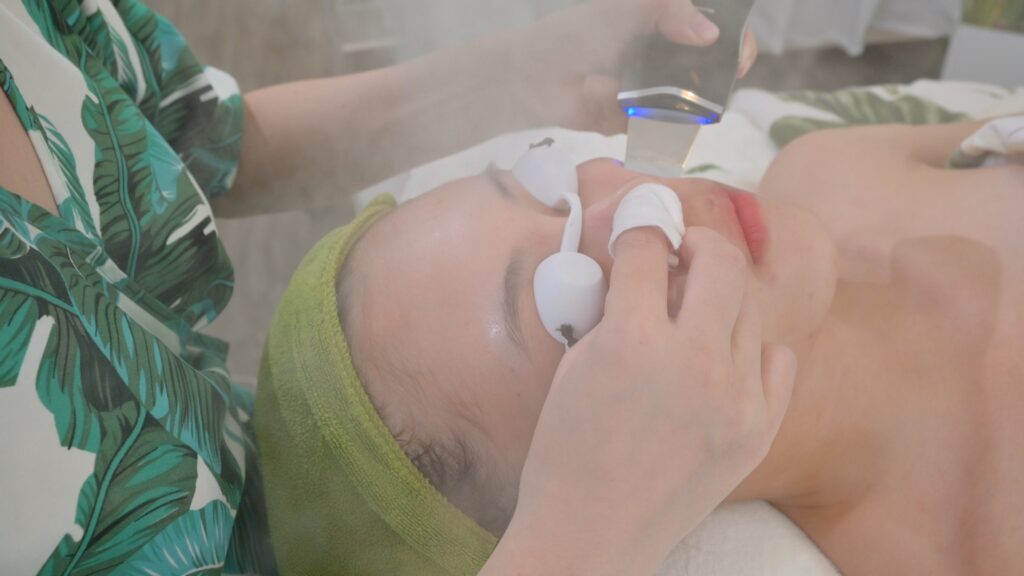
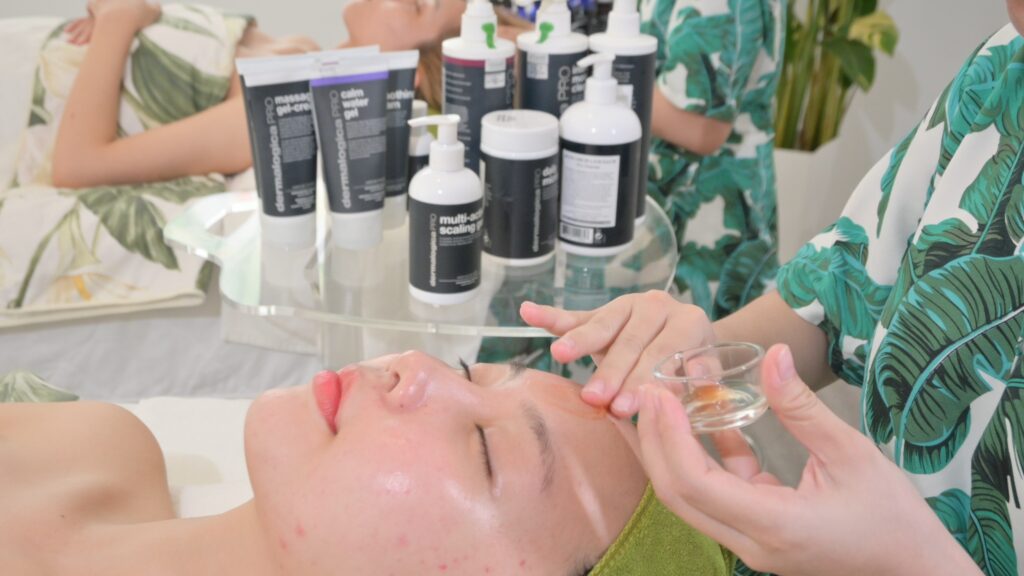
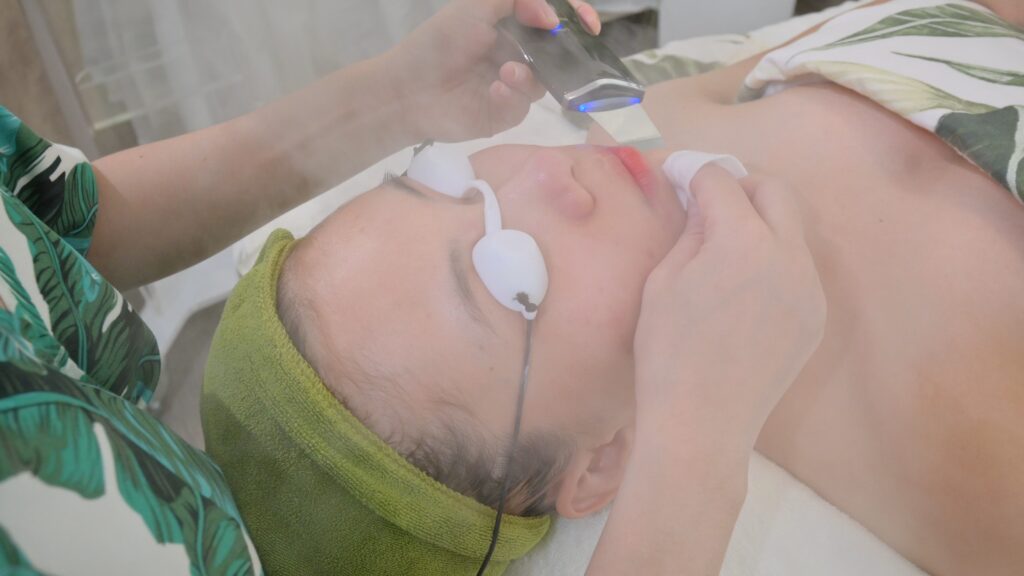
Step 1 — Skin cleansing: makeup removal, cleansing, exfoliation · Step 2 — Clearing congestion: steaming, acne softening, sebum extraction · Step 3 — Acne management: comedone extraction, antisepsis, disinfection · Step 4 — Soothing mask to reduce inflammatory swelling · Step 5 — Topical anaesthetic on the treatment area · Step 6 — The filler injection procedure · Step 7 — Antisepsis of the injection area · Step 8 — Recovery mask and Celluma LED · Step 8 — Moisturiser + sunscreen · Step 9 — Scalp massage, a short moment to relax. PK2, PK5, PK8 and PK11 have no separate protocol field in the price list, so none is inferred here.
⑧ Who is suitable — and who is not
Suitable: people with clearly localised volume deficiency in the lips, chin or temples; people with age-related volume loss needing support points re-established via MD Codes; people who want a visible change immediately and want to retain the option to reverse it.
Not suitable, or should wait:
- Significant sagging with the expectation that filler will lift the face — adding volume here makes the face heavier; a different tool group is correct.
- Active inflammation or infection in the intended area — active inflammatory acne, skin infection, active herpes labialis.
- Pregnancy or breastfeeding — wait.
- Active autoimmune disease, immunosuppressants, or anticoagulants — evaluation by the relevant specialist first, not a decision at the procedure table.
- Previous filler of unknown origin, or material suspected of being permanent, in that area — this must be assessed and addressed first; injecting on top complicates an already difficult problem.
- A skeletal problem of large magnitude — a plastic surgery consultation is the right referral.
- Expectations that do not match your own anatomy, or an acute period of stress driving an urgent change — the right response is to talk further, not to inject at the first visit.
- Known allergy to a product component or to hyaluronidase — being unable to use the reversal agent changes the entire risk balance.
⑨ Frequently asked questions
Lip filler complications — which one should I actually worry about?
The vascular group, because it is measured in hours rather than days. Call your doctor immediately for severe disproportionate pain, blanching followed by a net-like dusky discolouration, discolouration spreading beyond the injection site, or any eye symptom. For HA filler, management is hyaluronidase as early as possible.
If lip filler migrates or I am overfilled, can it be fixed?
With HA filler, yes. The doctor can dissolve it, locally or completely, and redo the work once tissue has settled. This is why Lona uses only HA and refuses permanent materials.
Which tier should I choose for chin filler?
It depends on the shape you want and your tissue. European lines sit close to bone, project the chin point and extend a V-line accurately, holding shape for 1 – 1.5 years. Italian lines are comfortable and natural but cannot create a sharply pointed chin. Korean lines give visible shape immediately at reasonable cost but may spread slightly at larger volumes.
Hollow temples and filler — is the temple a safe area?
The temple is one of the highest-caution areas for vascular anatomy and also has thin overlying skin, so correct injection depth is the whole issue. It is assessed and performed personally by the doctor.
Is Korean filler inferior to European filler?
The useful question is “different how”. Per the catalogue, Korean lines are gentler on budget, with smooth gel, integrated anaesthetic and fast integration; retention is around 6 – 10 months versus 12 – 18 for European lines, so top-ups come sooner.
What about Restylane and Juvederm — does Lona use them?
Those names are commonly cited as reference standards for European and American filler when discussing shape-holding and structural lift. Lona’s current catalogue uses the Lux tier — Vivacy, Teoxane/Teoxan, Apriline, Hyamax, Croma — and the Italian Pro tier. The specific product for your case will be named by the doctor and unsealed at the table before injection.
What is MD Codes?
Rather than filling one hollow, MD Codes places filler at anatomically defined ligament anchor points to re-establish volume support across the whole face, so it is used for ageing, mildly sagging skin.
How much does it cost in USD?
Approximately, at the reference rate above: Basic ≈ 160 – 220 USD/cc, Pro ≈ 360 – 400 USD/cc, Lux ≈ 320 – 480 USD/cc; MD CODES Basic from ≈ 560 USD/cc, MD CODES Lux from ≈ 560 USD, MD CODES Pro not listed and requiring examination first. These are approximate, for reference only, at 1 USD ≈ 25,600 VND. The VND figures are listed prices, excluding periodic offers, and subject to adjustment based on each patient’s specific condition.
Where can I get filler in Can Tho with an actual dermatologist?
Lona Skin Lab Dermatology Clinic (Phòng khám Chuyên khoa Da liễu Lona Skin Lab) in Can Tho — T2 Dinh Cong Trang Street, Ninh Kieu Ward, Can Tho City, Vietnam. Clinically responsible physician: MSc. Dr. Le Thi Thao Vy, Dermatology. Operating licence 735/CT-GPHĐ.
How long before my flight should the procedure be?
Lona recommends at least 2 weeks, with the exact interval given by your treating doctor. That window exists so you remain near the clinic if adjustment or management is needed — not merely so swelling settles.
When can I judge the final result?
Once tissue has settled, not while oedema is present. Timing is set by your doctor according to the area and product used, and that review visit is also when small refinements are made.
⑩ Home care after treatment
Three things are worth doing: adequate daily sun protection, since a recently treated area pigments more readily where bruising occurred; moisturising and barrier repair, particularly on lips after shaping; and gentle cleansing in the first days, without rubbing the injected area. Corresponding product groups are at lona.vn — the sunscreen group, the barrier-repair moisturiser group, and the post-procedure soothing group.
⑪ Message Lona
If you are weighing up filler tiers, or you are concerned about an injection done somewhere else, message us for a treatment plan from a dermatologist and skin-analysis technician:
- Messenger: https://m.me/lonaskinlab.vn?ref=cum-07
- Zalo: https://zalo.me/4428027389339512399
- Hotline: 0777 679 902
From abroad: WhatsApp +84 777 679 902 · Contact@lona.vn.
Lona Skin Lab Dermatology Clinic (Phòng khám Chuyên khoa Da liễu Lona Skin Lab) T2, đường Đinh Công Tráng, phường Ninh Kiều, TP. Cần Thơ. Hotline: 0777 679 902 · 0932 927 723 Operating licence: 735/CT-GPHĐ · Advertising licence: 4770/XNQC-SYT Clinically responsible physician: ThS.BS Lê Thị Thảo Vy — Dermatology
Chú ý: Nội dung bài viết chỉ mang tính chất tham khảo, không thay thế cho việc chẩn đoán hoặc điều trị y khoa. Vui lòng tham khảo ý kiến bác sĩ trước khi áp dụng bất kỳ phương pháp nào. Xem thêm