

One question should be answered before all the others: is the thing you want to reduce actually fat?
A great many people arrive wanting to “reduce the double chin”, “slim the face”, “shrink the upper arms” — and after examination it turns out the real problem is skin laxity, or fluid retention, or the underlying jaw structure, not the subcutaneous fat layer. Those three look alike in a mirror but need three completely different approaches, and choosing wrong is the most common reason a course of treatment “does nothing”.
This article is about localised fat — the kind that sits in one place, does not shrink with your body weight, and only responds to local intervention. If you are reading this from abroad and planning a trip home, start with section 2: this is a multi-session protocol, and that fact has to shape your travel dates, not the other way round.
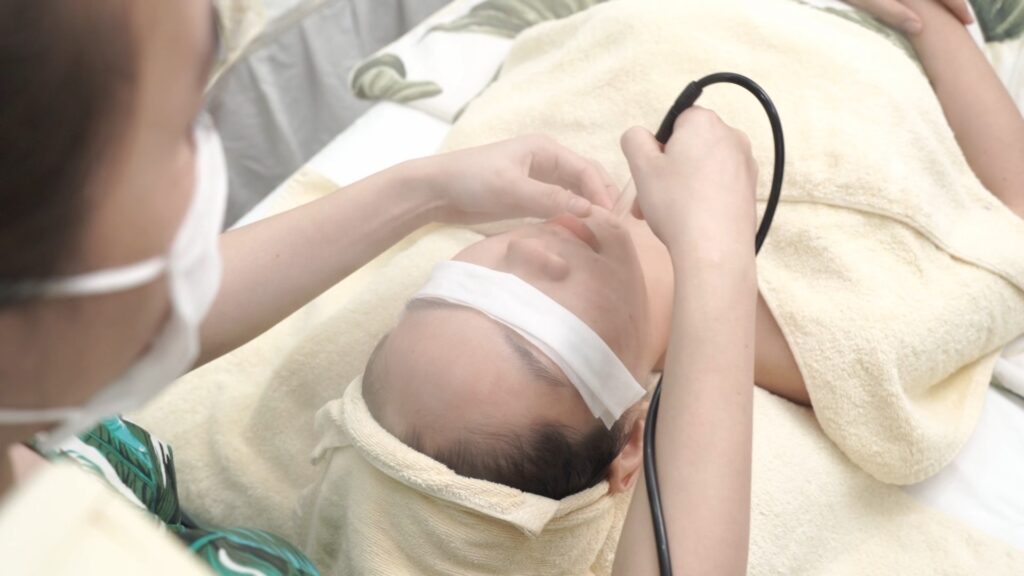
1. What localised fat is, and why it ignores your body weight
Subcutaneous fat is neither distributed nor mobilised evenly. When the body enters an energy deficit, it draws on the depots that are easiest to mobilise first. Some other depots — fibrous white fat, under hormonal influence — sit outside that priority order. This is the fat people call “stubborn”: it is still there after strict dieting and high-intensity cardio, while the rest of the body has visibly slimmed down.
The classic localised depots, each with its own character:
The submental fat pad. The mass between chin and neck, most visible when you look down or while you are talking. As it thickens, the transition between chin and neck is erased and the jawline loses definition — the face reads as heavy and gives the “double chin” impression even at a normal body weight.
Facial fat and infraorbital fat. The periorbital region has a distinctive anatomy: fat pads are held in place by a partition called the orbital septum. As that septum slackens with age, the fat herniates forward and creates under-eye bags. What few people realise: most of the “dark circles” in this group are not pigment but shadow — the protruding pad creates a surface step between the lower lid and the cheek, and that shadow is the dark streak you see. Applying a brightening cream to a shadow achieves nothing.
Thigh fat. Distributed in two patterns: the inner thigh, where friction occurs when walking, and the outer thigh — the “saddlebags”. Both are fibrous, hormonally influenced fat. The thigh carries a second, coexisting problem: cellulite, which is not fat alone but fibrous bands tethering the skin surface inward combined with fat congestion beneath — making it a dual problem, part volume and part texture.
Upper-arm fat. Fat on the underside and back of the upper arm, colloquially “bat wings”: loose, pendulous tissue that moves when the arm moves and is notoriously hard to firm up with exercise alone.
Four things that routinely get conflated:
| What you see | What it actually is | Direction of treatment |
|---|---|---|
| The area is thicker; you can pinch a soft mass | Localised fat — excess volume | Local lipolytic intervention |
| The area is slack; skin slides over the base | Laxity — loss of support | Lifting technologies, not fat reduction |
| Puffy in the morning, better by evening | Oedema, microcirculatory congestion | Improve drainage, not fat reduction |
| Measurements up all over the body | Generalised excess weight | Nutrition and exercise, not a procedure |
Those four rows are why this cannot be self-diagnosed from a selfie. Only examination and palpation separate them.
2. Travelling in for treatment: how to plan the trip
For this service group, distance has a particular twist compared with others: this is a multi-session course, not a single appointment. That belongs in the plan before you book flights.
From overseas. This is the group that needs to ask the most questions, and the most important one is not price. It is: how many days is my trip, and does this protocol fit inside it? A 3–5 session course may not fit into a short visit. Three things to do:
1. Get a remote consultation before you fly. Send photos and a description via WhatsApp +84 777 679 902, Zalo, or Contact@lona.vn. That consultation exists to answer two questions — are you a candidate, and how many sessions your area is likely to need — before you book tickets, not after. 2. Group procedures into one block. Patients travelling from a distance should let the doctor sequence and space the interventions across exactly the window you are in Vietnam. 3. Lona recommends leaving at least 2 weeks between a procedure and your flight. This is the clinic’s general recommendation; the specific interval for your procedure is set by your treating doctor. For injectable protocols the reason is practical: bruising and swelling are minimal, but local reactions can still appear in the first few days, and you want to still be in Vietnam during that window so you can be seen in person if needed, rather than managing it by message from the other side of the world.
From Ho Chi Minh City to Can Tho. If each session costs you a weekend day on the road, total up the number of trips before starting. Two things reduce that count: message ahead with photos so the doctor has a preliminary picture, then consult and treat in the same visit; and if you have several areas to address, ask whether they can be combined into one session — that depends on total active dose and is the doctor’s call.
From the Mekong Delta provinces to Can Tho. The procedure itself is quick — the submental injection step runs about 15–20 minutes, plus the cleansing and recovery steps before and after. Bruising and swelling are minimal and normal activity resumes the same day, so a same-day round trip is realistic. The thing to ask at the first visit is the interval between sessions, so you can fit the whole course into your own travel plans rather than reacting one session at a time.
Currency note for all prices in this article. Figures are in Vietnamese dong (VND). For reference only, this article uses a rounded rate of 1 USD ≈ 25,600 VND (so 4,000,000đ ≈ 156 USD). These conversions are approximate, for reference only — check the live rate before budgeting, and treat the VND figure as the actual quoted price.
3. A full map of fat-reduction approaches — including what Lona does not do
The “offered” and “not in the catalogue” labels below reflect the published service catalogue as of October 2026. If you need a direction that is not listed, ask — if it is not something done here, you will be told so directly and pointed somewhere suitable.
1. Surgical liposuction. Mechanism: fat is removed through an incision, under anaesthesia. Suits: large volumes, where a decisive change in one sitting is required. Limits: anaesthesia, incisions, risk of major vascular injury, weeks in compression garments, extended recovery. The strongest intervention, and also the one with the most conditions attached.
2. Injection lipolysis (mesotherapy lipolysis / tiêm tan mỡ). Mechanism: medical lipolytic agents are delivered directly into the subcutaneous fat layer, disrupting the adipocyte membrane, liquefying the lipid, and leaving the body to clear it naturally via the lymphatic circulation and excretory system. Agent groups commonly found in such protocols: lipolytics (deoxycholate, phosphatidylcholine) and circulation- and metabolism-supporting components (L-carnitine, caffeine, artichoke extract, Centella asiatica). Suits: localised depots in people at normal weight or mildly overweight. Limits: needle-based and therefore invasive, requires several sessions, and is not a weight-loss method.
3. Energy-based skin tightening after the fat is gone. Mechanism: heat to contract and regenerate collagen so the skin retracts in step with the lost volume. Suits: a supporting role after or alongside fat reduction, not as fat reduction. Limits: no substitute for a lipolytic intervention when the primary problem is excess volume.
4. “Belly fat-dissolving” patches, teas, creams and supplements. The advertised mechanism is that an active crosses the skin, or is swallowed, and “burns” fat in a specific spot. The core problem is anatomical: localised fat sits inside the subcutaneous layer, beneath the epidermal barrier, and a patch applied to the surface cannot deliver an active to that depth at any meaningful concentration. The sense that the area is smaller right after use usually reflects local fluid loss and mechanical pressure, not ruptured adipocytes. Lona neither uses nor sells this category. If you are considering it, treat it as a consumer purchase, not a treatment cost.
5. Weight-loss medication and systemic medical management. This is the territory of endocrinologists and nutrition specialists and requires a full metabolic assessment. It is outside the scope of an aesthetic dermatology clinic.
What Lona Skin Lab does not do. We do not perform surgical liposuction, do not prescribe weight-loss medication, do not offer whole-body weight reduction, and do not use fat-dissolving patches or supplements. If, after examining you, the doctor finds the depot too large for injection lipolysis, or finds that the real issue is generalised excess weight, you will be told so directly and referred to the appropriate specialty — including when the conclusion is that no service here is right for you.
4. Which direction Lona takes, and why
We perform localised injection lipolysis using the RRS Cellutrix line, with a deliberately narrow purpose: clearing fat via the lymphatic and excretory systems at precisely the area where the contour needs refining.
Three reasons this direction fits the clinic’s patients.
First, it matches the actual problem most of them have. Most do not need to lose weight — their overall weight is normal or only mildly elevated, but fat has concentrated in one spot that spoils the contour. For that problem, a local intervention is more rational than any systemic approach.
Second, the fat clears gradually — and that is an advantage, not a drawback. Crash weight loss or bulk fat removal tends to leave crumpled, slack skin because the skin cannot retract fast enough. Gradual clearance gives the overlying skin time to contract in step. Modern protocols also combine the lipolytic agents with components that stimulate microcirculation and tissue remodelling to support that retraction.
Third, no anaesthesia, no incision, no long recovery. The procedure is minimally invasive with little bruising or swelling, and patients can resume normal activity the same day — which matters for patients travelling in, who have to account for every day of the trip.
5. Comparison of the four treatment areas
Read by the area you care about.
| Problem to solve | Service | Brand / product used | Invasive | Area | Listed price range |
|---|---|---|---|---|---|
| Thick submental fat pad, blurred jawline, “double chin” | PK34 — Submental injection lipolysis | RRS Cellutrix | Yes | Face (submental) | 4,000,000đ – 5,000,000đ (≈160–200 USD) |
| Infraorbital fat, deep tear trough, shadow-type dark circles | PK37 — Facial injection lipolysis | RRS Cellutrix | Yes | Face | from 4,000,000đ (≈156 USD) |
| Inner thigh, outer thigh (saddlebags), peri-knee fat, cellulite | PK35 — Thigh injection lipolysis | RRS Cellutrix | Yes | Thighs | 4,000,000đ – 5,000,000đ (≈160–200 USD) |
| “Bat wing” fat on the underside and back of the upper arm | PK36 — Upper-arm injection lipolysis | RRS Cellutrix | Yes | Arms | 4,000,000đ – 5,000,000đ (≈160–200 USD) |
All figures above are listed prices, not including period-specific offers, and subject to adjustment based on each patient’s actual condition. USD figures are approximate, for reference only, at a rounded rate of 1 USD ≈ 25,600 VND. Session counts are not fixed either: per the protocol descriptions, the submental, facial and arm areas typically need around 2–4 sessions and the thighs around 3–5, with the real number depending on the thickness of the fat layer. These are reference ranges, not commitments.
One point worth noticing in the table: all four services use the same product line but not the same protocol. The periorbital region has the most sensitive and complex anatomy, so protocols there typically add biological peptides and microcirculatory support — biomimetic peptide complexes, Ginkgo biloba extract, Ruscus — rather than focusing on lipolysis alone. The thigh is the opposite case: the protocol has to account for cellulite, which is a texture problem and not only a fat problem.
6. What a session actually involves
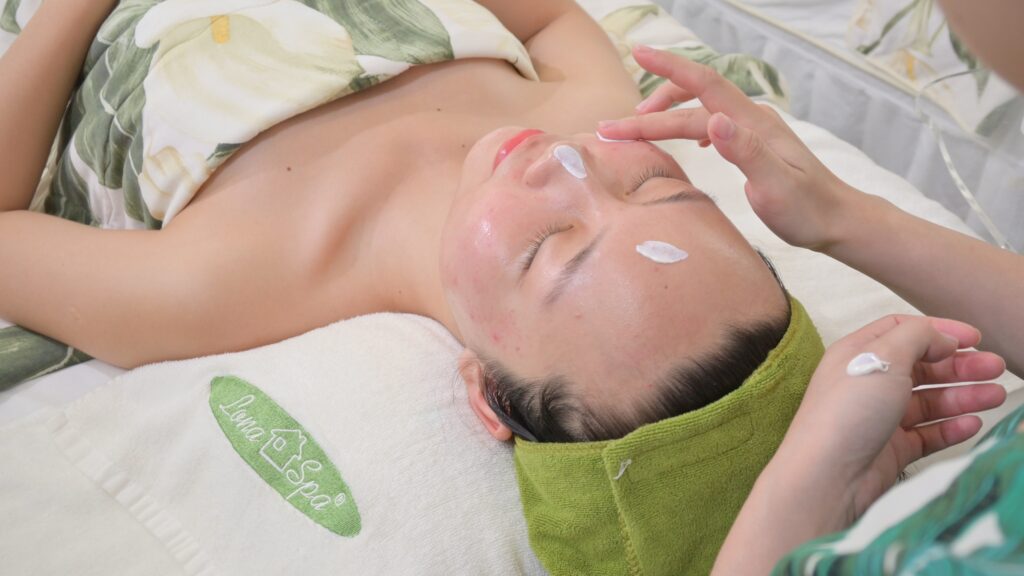
All four services in this article follow the same listed protocol:
1. Cleanse: makeup removal, wash, exfoliation 2. Decongest: steam, acne-softening mask, oil extraction 3. Acne management: extraction, antisepsis, disinfection 4. Soothing mask to reduce swelling and inflammation 5. Topical anaesthetic on the treatment area 6. The mesotherapy injection procedure 7. Cold iontophoresis to calm the skin 8. Recovery mask and Celluma LED 9. Moisturiser and sunscreen 10. Scalp massage — a little relaxation to finish
Two things are worth saying about that sequence. The anaesthetic step before injection is mandatory, not optional — it determines whether the doctor can work the needle slowly and precisely enough. And the post-injection calming step — cold iontophoresis plus the recovery mask and LED — is not padding to make the visit feel expensive: it reduces the local swelling response, which is the main thing that makes patients hesitant after a first session.
The submental injection step itself runs about 15–20 minutes.
7. Who is a candidate — and who should wait
Clear candidates:
- Normal overall weight or mildly overweight, with fat concentrated in one defined area.
- A reasonably balanced build but fat concentrated in the lower body or upper arms that resists exercise.
- A visible submental pad that shows when looking down or talking, or a jawline blurred by excess fat spilling toward the lower jaw angle.
- Mild to moderate infraorbital fat herniation, or pseudo-bags from fluid congestion combined with mild fat, not yet at the threshold for surgery.
- Anyone wanting to refine a contour but unwilling to undergo surgical liposuction.
Who should wait:
- Anyone clearly overweight overall. Injection lipolysis is a contour-refining tool for a specific site, not a weight-loss tool. If your problem is weight, address nutrition and activity first — the localised fat still left afterwards is what a procedure is for.
- Women who are breastfeeding. Per the indications, the postpartum group is suitable only after breastfeeding has stopped.
- Anyone whose real problem is skin laxity rather than fat. Removing fat from an already slack area makes it slacker. This case has to be separated out by examination before any decision.
- Severe fat herniation around the eyes, or lower-lid skin that is already visibly crepey and folded. This group needs a surgical assessment; injection lipolysis will not address it.
- Anyone expecting a procedure to substitute for lifestyle. Fat cleared from one area does not stop the body storing new fat if the energy balance is unchanged.
- Active skin infection or an unhealed wound at the treatment site. That must resolve first.
See a different specialist first: anyone with an unassessed metabolic, thyroid or endocrine disorder, or taking medication that affects coagulation. This has to be clarified at the consultation and cannot be skipped.
8. Frequently asked questions
1. What is injection lipolysis and how does it work?
Medical lipolytic agents are delivered directly into the subcutaneous fat layer. The agents disrupt the adipocyte membrane, the lipid is liquefied, and it clears naturally via the lymphatic circulation and the excretory system. Because the action is local, it thins the fat layer only where it is injected.
2. Will facial fat reduction leave my face hollow?
This is exactly why examination comes first. If the real problem is excess localised fat, clearing it refines the contour. If the face already lacks fat padding, removing more will make it look older rather than slimmer. Only examination and palpation distinguish the two situations.
3. Do belly fat-dissolving patches actually work?
Localised fat sits inside the subcutaneous layer, beneath the epidermal barrier, so a surface patch struggles to deliver an active to that depth at a meaningful concentration. The feeling that the area shrank right after use typically comes from local fluid loss and mechanical pressure. Lona neither uses nor sells this category.
4. Is a double chin always caused by fat?
No. A double chin can come from a thick submental fat pad, from laxity of the submental skin and muscle, from jaw and chin structure, or from several of these at once. Only the first responds to fat reduction; the others need a different direction.
5. Can high-tech body contouring replace diet and exercise?
No, and this is worth being clear about from the start. Local interventions address depots that do not respond to lifestyle. They do not change the body’s energy balance, so if that balance is unchanged, new fat still accumulates.
6. Can fat on the buttocks and back of the thighs be treated?
The listed service in this group covers the thigh, and its protocol accounts for improving the dimpled, uneven cellulite texture on the back of the thighs and buttocks. The exact scope for your case is established by the doctor after examination.
7. Does it hurt, and will I need time off work?
A topical anaesthetic is applied before injection, and the session ends with cold iontophoresis plus a recovery mask and LED. The procedure is minimally invasive with little bruising or swelling, and per the protocol description patients can resume normal activity the same day. If you have an important event, still leave a few days for local reactions to settle.
8. Can I have this after giving birth?
Yes, but per the indications only after breastfeeding has stopped. If you are currently breastfeeding, this is a case for waiting.
9. Where can I get non-surgical submental, thigh or arm fat reduction in Can Tho, Vietnam?
At Phòng khám Chuyên khoa Da liễu Lona Skin Lab (Lona Skin Lab Dermatology Specialist Clinic) in Can Tho — T2, đường Đinh Công Tráng, phường Ninh Kiều, TP. Cần Thơ. The first visit is an examination to separate localised fat from laxity and from fluid retention, because those three need three different approaches.
10. Once the fat is gone, will the skin be slack?
A reasonable concern, and the reason modern protocols pair lipolytic agents with components that stimulate microcirculation, metabolism and tissue remodelling. Because the fat clears gradually rather than all at once, the skin has time to retract in step. If there is already visible laxity before treatment, the laxity needs to be discussed as a separate question up front.
9. Home care during the course of treatment
Liquefied fat has to be cleared through the lymphatic and excretory systems — meaning your body does the remaining work, and you can help it. Three things to do throughout the course: drink enough water, move gently every day to support lymphatic drainage, and keep your energy balance steady so the fat just cleared is not replaced by new fat.
For local care: a freshly injected area needs calming and barrier support, especially on the face and around the eyes, where the skin is thinnest and most reactive. The soothing and barrier-repair range and the sunscreen range are available at lona.vn; a treated facial area needs the same strict sun protection as any other intervention.
10. Message us
The first question at the consultation is not “how much do you want to lose” but “is that area fat, laxity, or fluid”. Send photos and a description so a dermatologist and a skin-analysis technician can give you a direction first — especially if you are travelling in and need to know how long the course runs before you fix your dates.
- Messenger: https://m.me/lonaskinlab.vn?ref=cum-08
- Zalo: https://zalo.me/4428027389339512399
- Hotline: 0777 679 902
- WhatsApp: +84 777 679 902 · Email: Contact@lona.vn
Phòng khám Chuyên khoa Da liễu Lona Skin Lab T2, đường Đinh Công Tráng, phường Ninh Kiều, TP. Cần Thơ. Hotline: 0777 679 902 · 0932 927 723 Operating licence: 735/CT-GPHĐ · Advertising licence: 4770/XNQC-SYT Medical director: ThS.BS Lê Thị Thảo Vy — Dermatology
Chú ý: Nội dung bài viết chỉ mang tính chất tham khảo, không thay thế cho việc chẩn đoán hoặc điều trị y khoa. Vui lòng tham khảo ý kiến bác sĩ trước khi áp dụng bất kỳ phương pháp nào. Xem thêm